
Learning Through Play and Stories: Lowering Barriers to Emotional Reflection

Jun 19, 2026



Student wellbeing programs depend not only on access to support, but also on whether children feel able to describe their experiences accurately. In a study of 157 fourth-grade children, one-to-one interviews elicited significantly more socially desirable responses than classroom-based assessments.[1] For schools, allied health providers and child-focused organisations, this highlights a practical limitation: a direct check-in may capture the answer a child believes is expected rather than the experience requiring attention.
Learning through play and stories offers a complementary engagement model for addressing this limitation. This article examines how play- and story-based approaches can lower barriers to emotional reflection and complement existing student wellbeing support.
Australian schools use counselling, pastoral care and targeted assessments to support student wellbeing. The Australian Government’s My Mind Check provides participating schools with a voluntary mental health and wellbeing check-in. NSW public schools also provide access to counsellors and psychologists who assess identified learning and mental health needs.[2][3]
These mechanisms provide important routes to support, but their results depend on what children are prepared and able to report. Even a supportive check-in may feel like an assessment, leading a child to consider which response is acceptable rather than most accurate.

Researchers describe this as social desirability bias: overstating socially approved behaviour or understating experiences that may attract criticism. In a study involving fourth-grade children, one-to-one interviews produced significantly more socially desirable responses than classroom-based assessment.[1] The finding does not suggest dishonesty - it shows that the social setting can influence self-report.
Several factors can sit between a child’s experience and the answer an adult receives:
Fear of judgement: A child may avoid appearing weak, difficult or less capable.
Expected adult response: Children can infer which answer will satisfy a teacher, parent or other authority figure.
Pressure to explain: An honest answer may lead to follow-up questions the child is not ready to answer.
Limited emotional language: A child may recognise discomfort without having the vocabulary to distinguish worry, embarrassment, disappointment or frustration.
Point-in-time reporting: One answer may not show whether an experience is temporary or recurring.
More direct questioning does not necessarily resolve these barriers. In some situations, it can increase the child’s awareness that they are being evaluated.
A direct wellbeing question begins with the child: “How are you feeling?” A story begins with someone else. By shifting the focus to a character or imagined situation, stories allow children to explore an emotion without immediately making a personal disclosure.
For example, a character may no longer want to join a familiar classroom activity. The child can consider what happened, how the character might feel and what could help, without assuming the situation represents their own experience.
Play adds participation. Children can respond to a situation, consider an action and observe what follows instead of explaining an abstract feeling. Research suggests that pretend play can support perspective-taking, emotion recognition and emotional regulation, although the quality and structure of the activity remain important.[4] A meta-analysis of 19 studies involving 749 children also found improvements in emotion understanding through programs using stories, games, discussion and role-play.[5]
Structured play and stories can lower barriers to emotional reflection through five mechanisms:
Psychological distance: Children begin with a character rather than place themselves under scrutiny.
Concrete situations: Emotions are connected to events, reactions and consequences.
Alternative response modes: Games allow children to respond through actions and choices.
Active participation: Children explore the situation rather than become passive subjects of an assessment.
Familiarity through repetition: Regular, low-pressure activities make reflection part of an everyday routine.
These mechanisms do not force disclosure. They help children engage with emotional ideas before deciding whether to relate those ideas to themselves.
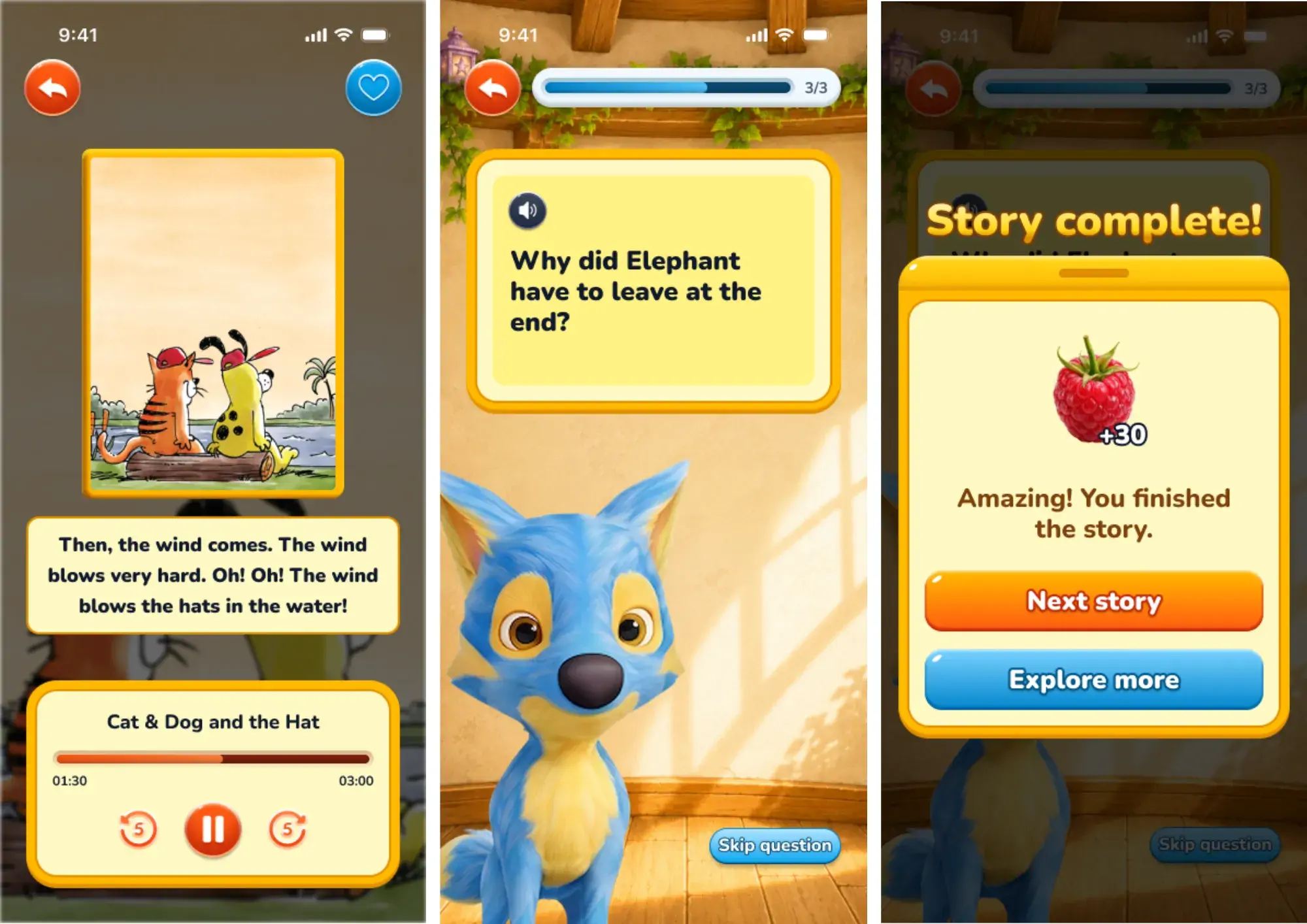
AI Companion for Kids applies these principles through guided stories, reflective questions and short learning games in a voice-first format. It extends learning through play into repeatable activities across a mobile device, tablet or handheld companion.
Voice-first access: Children can participate without relying exclusively on reading, typing or questionnaires, reducing the activity’s literacy demands.
Guided interaction: Children interpret a character’s experience, respond to prompts and make choices through play. Reflection feels closer to an everyday conversation than a formal assessment.
Ongoing context: Regular activities build familiarity. Over time, engagement history, recurring themes and mood signals may give parents and relevant professionals context for subsequent conversations.
For children
Learning through play and stories creates an intermediate step between an experience and reporting it to an adult. Children first explore an emotion’s language, causes and consequences through fiction, supporting emotional health and wellbeing by giving personal reflection room to follow when they feel ready.
For parents and carers
Parents and carers gain a better starting point for conversation. Instead of asking “What is wrong?”, they may have enough context to raise a specific situation or pattern. They must still listen, avoid premature conclusions and consider what else is happening in the child’s life.
For schools and allied health providers
Schools and allied health providers can maintain engagement between structured sessions. For organisations promoting emotional wellbeing in schools, this continuity complements existing student wellbeing support without making every interaction a formal assessment. AI Companion for Kids is designed to operate across home, classroom and support settings, allowing reading, listening and emotional check-in habits to continue.
Children may recognise an emotion without feeling ready to report it. Learning through play and stories provides a lower-pressure way to explore feelings, while games and voice conversations make reflection less formal. Through guided stories, questions and activities, AI Companion for Kids gives trusted adults additional context without seeking to determine what a child feels.
Schools and child-focused organisations considering this model should evaluate its support for engagement alongside its content governance, privacy controls, human oversight and escalation processes.
Why might children give the expected answer in a wellbeing check-in?
Children may anticipate which response appears acceptable or avoids further scrutiny. This socially desirable response can be influenced by the adult present, the wording of the question and the perceived consequences of answering.
How do stories reduce the pressure to self-disclose?
Stories place the initial focus on a character or situation. Children can explore emotions and possible responses without being required to say that the experience applies to them.
What does play add to emotional reflection?
Learning through play gives children an active way to explore a situation through decisions and responses. This can make reflection feel less like a formal assessment and more like an everyday activity.
How can play-based activities support emotional health and wellbeing?
Guided stories and games connect emotions to situations, choices and consequences. They can help children practise emotional language and reflection in a lower-pressure setting, while giving trusted adults a more specific starting point for supportive conversations.
How should organisations evaluate an AI companion provider?
They should examine child-centred design, content governance, privacy, access controls, human oversight and escalation procedures. Vendors should also explain the evidence and limitations behind their wellbeing claims.
References
[1] Miller, P. H. et al., Children’s Social Desirability: Effects of Test Assessment Mode, Personality and Individual Differences, vol. 83, September 2015, pp. 85–90.
[2] Australian Government Department of Education, Privacy Impact Assessment Report: Voluntary Mental Health Check Tool, 6 August 2024.
[3] NSW Department of Education, About the School Counselling Service, updated 11 August 2026.
[4] Gleason, T. R. and White, R. E., Pretend Play as Abstraction: Implications for Early Development and Beyond, Neuroscience & Biobehavioral Reviews, April 2023.


Table of content

Related Insights
Employee Training and Development for Workforce Capability
Explore how enterprises can connect employee training, coaching and skills development to build workforce capability at scale....

System Integration Solutions for Connected Operations
Discover how system integration solutions connect enterprise data, workflows and AI with existing systems to reduce fragmentation and improve operational visibility....

AI in Physical Security: Smarter Security for Australian Enterprises
Explore how AI in physical security transforms CCTV into intelligent monitoring with real-time threat detection, video analytics and smarter security for Australian enterprises....

Let’s build what’s next for your business
Tell us about your business challenges, we’ll help you shape the right solution.

