
Employee Training and Development: Building Workforce Capability at Scale

Jun 19, 2026



Workforce skills are changing faster than many traditional training cycles can respond. The World Economic Forum estimates that 39% of workers’ existing skill sets will be transformed or become outdated by 2030, while 63% of employers identify skills gaps as a major barrier to business transformation. As AI reshapes work, 77% of employers also plan to upskill or reskill existing workers to work more effectively alongside AI [1].
For enterprises, the larger challenge is ensuring that people continuously develop capabilities aligned with changing roles, technologies and business priorities.
Employee training and development therefore needs to evolve from managing isolated learning activities towards building a connected capability journey. Enterprises need learning and development, practice, assessment and skills information to work together so workforce capability can evolve with changing business requirements.
Rather than simply digitising existing training activities, organisations need a more continuous development model that can adapt as roles, technologies and capability requirements change.
A useful distinction is between activity and capability.
Learning Activity | Workforce Capability |
|---|---|
Courses assigned | Required skills identified |
Modules completed | Capability demonstrated |
Learning recorded | Capability applied to business needs |
Completion data tells the organisation what learning took place. It does not necessarily show whether employees now possess the capabilities required to execute business strategy.
Australian data shows that skills development is already an active business concern. In 2024–25, 35% of Australian businesses reported experiencing skills shortages. Among businesses facing shortages, 38% increased on-the-job or internal training, while 26% invested in upskilling or reskilling existing employees [2]. Jobs and Skills Australia also notes that the quality, relevance and practical application of learning can matter more than the amount of training delivered [4].
Employee training and development therefore needs to be evaluated by the capability it develops, not simply by the volume of learning completed.
Large organisations rarely lack development activities. The more common problem is that training, coaching, skills assessment, performance data and career development can sit across different platforms, teams and programmes. As a result, learning and development may be visible as separate activities while the broader capability journey remains fragmented.
Australian Government guidance distinguishes training, which generally develops skills required for a current role, from professional development, which supports broader capability and career growth [3]. For enterprises, the priority is therefore to connect current-role training with longer-term development, coaching and capability building rather than manage them as separate programmes.
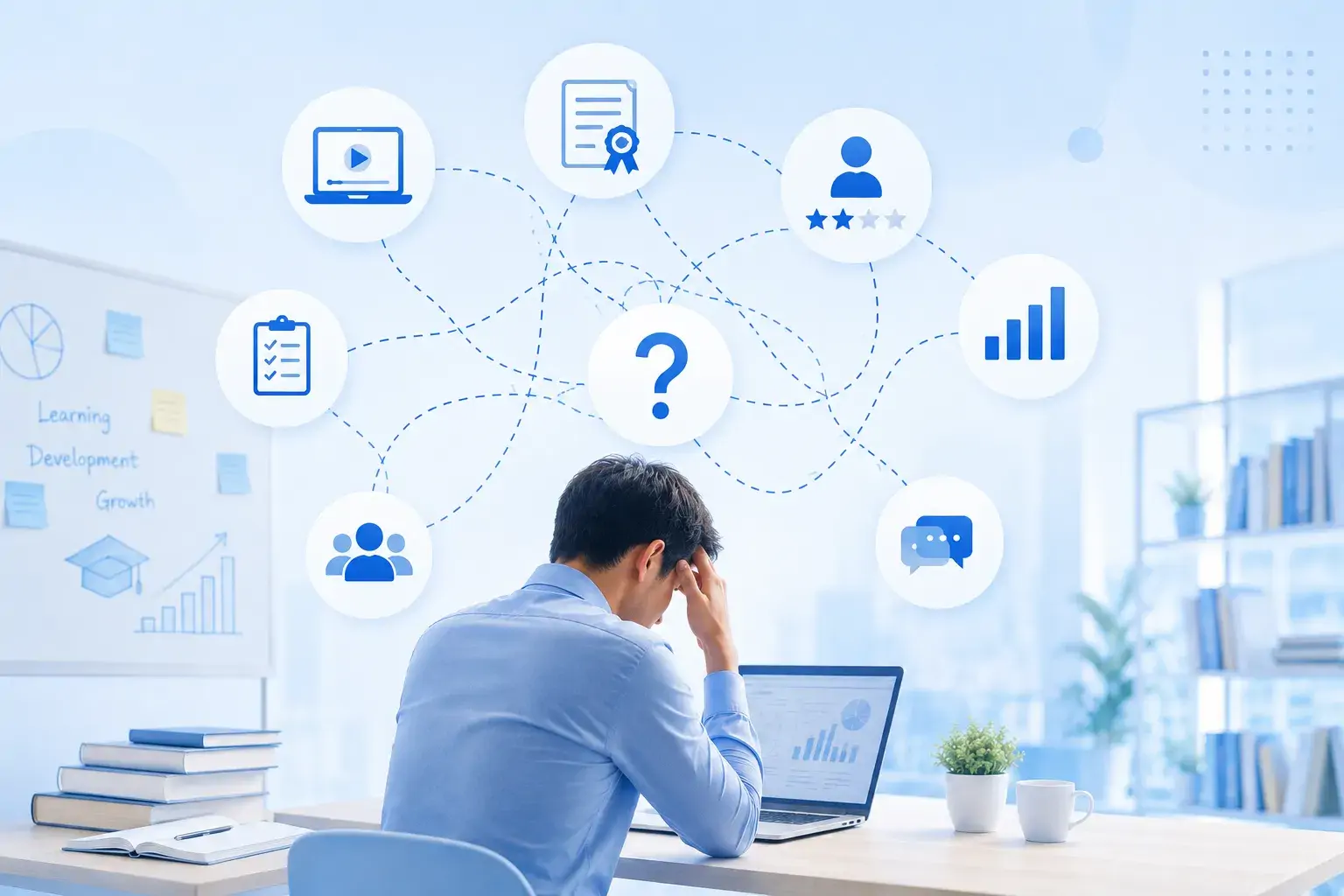
Personalised Development Is Hard to Scale
Employees differ in existing skills, capability gaps, roles, career objectives and readiness levels, so a single curriculum cannot provide the most relevant development path for everyone. At enterprise scale, the challenge is to personalise development across hundreds or thousands of employees without creating equivalent growth in manual administration or fragmented programmes.
For enterprise L&D and workforce leaders, the business requirement is not simply more training. The priority is a development model that connects what capability is required, how employees develop it, how progress is demonstrated and how that information informs the next development decision.
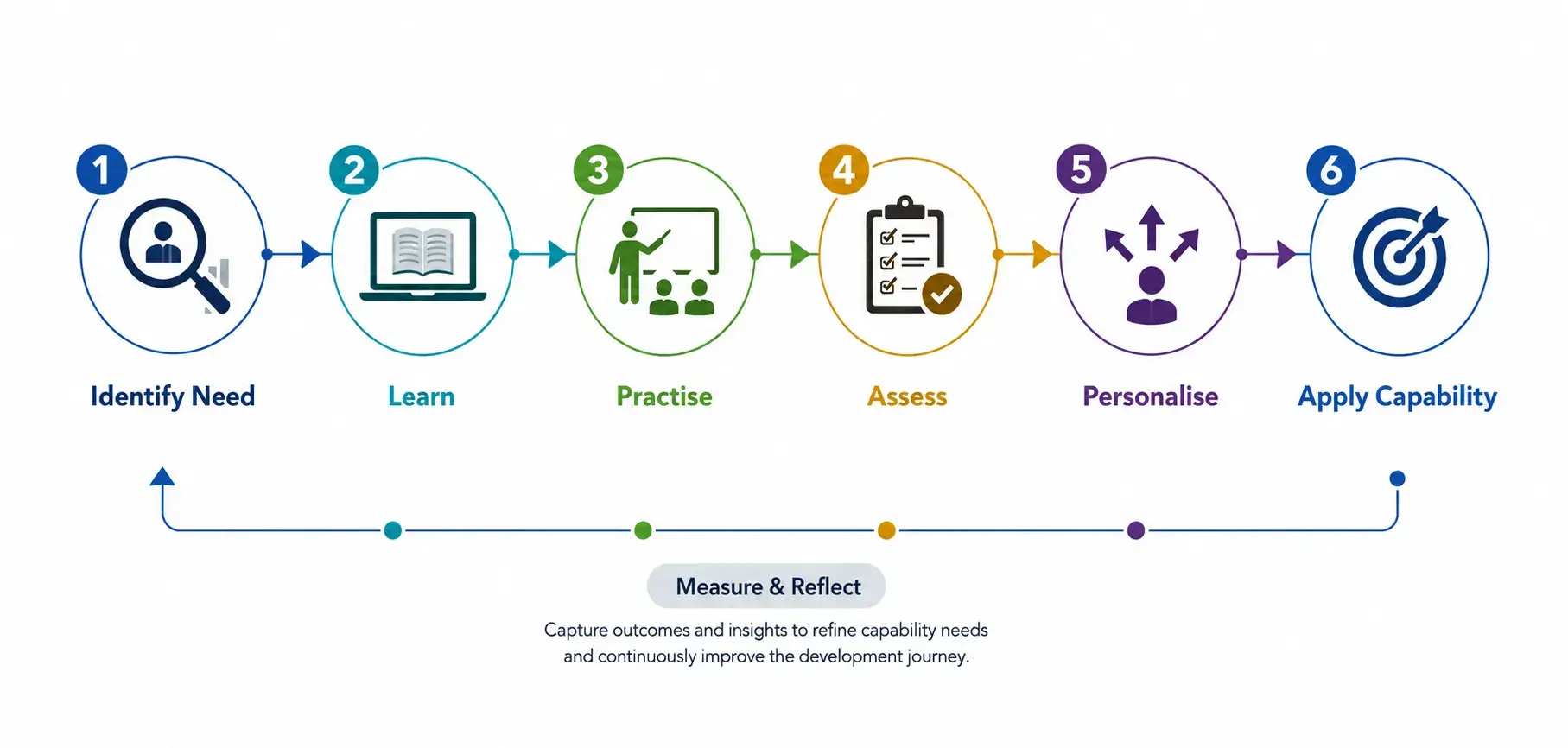
This shifts employee training and development from managing content consumption towards managing capability progression. Each stage should inform the next, from identifying what capability is required to developing, assessing and personalising learning before applying that capability where it can create business value.
In practice, this connected model depends on information moving between each stage of development. Skills requirements guide learning priorities, while practice and assessment provide evidence of progress, helping enterprises identify remaining gaps and determine the next development action.
Connected data, configurable workflows and appropriate automation can then help enterprises scale personalisation without manually designing a separate programme for every employee. Technology should improve visibility and coordination while preserving human judgement where context matters.
Connected learning, assessment, coaching and skills information gives enterprises a clearer view of:
What capability exists → Where gaps remain → What development should follow
This gives learning and development teams a stronger basis for targeting investment around actual capability requirements rather than assigning identical programmes across the workforce. Jobs and Skills Australia’s research on employer investment in learning reinforces this direction, finding that learning aligned with workplace needs is more likely to build skills, improve productivity and support career progression [4].
Development also creates greater workforce value when skills can be recognised and applied where they are needed. Jobs and Skills Australia highlights the importance of recognising and transferring skills as workforce requirements change [7].
The business outcome is not simply more learning activity. It is better skills visibility, more targeted development, continuous capability building and stronger alignment between workforce capability and changing business needs.
Capability before content. Start with the skills and business capabilities the organisation requires rather than the volume of courses available.
Connection before automation. Training, coaching, assessment and development data need shared context before automation can create meaningful value.
Personalisation without fragmentation. Tailored development should rely on connected data and workflows; otherwise, personalisation can create additional operational complexity.
Enterprises may already manage learning and development, coaching and skills information through different tools and processes. The priority is to ensure these capabilities support a connected development journey rather than operate as separate activities. Structured learning needs to be managed consistently, employees need opportunities to practise and demonstrate capability, and skills information needs to support subsequent development or workforce decisions.
Manage Structured Learning with KPS TMS
KPS Training Management System supports structured learning, assessment and learner-progress workflows within a connected environment [5]. In a workforce development context, this provides an operational foundation for managing formal learning while making training information available for subsequent development decisions.
This gives L&D teams a more consistent view of formal learning and progress, reducing reliance on disconnected records and providing stronger information for subsequent capability decisions.
Practise and Improve with KPS AI Coaching
KPS AI Coaching for Sales Agents demonstrates how technology can add a practice and feedback layer through AI-powered roleplay, personalised learning paths, performance scoring, behavioural analysis and skill-gap identification [6]. Although designed for sales environments, these capabilities illustrate how AI can support the Practise, Assess and Personalise stages of a broader learning and development journey by making repeated practice and feedback easier to scale, while giving development teams clearer evidence of where employees are improving and where further support is needed.
Connect Skills to Roles with KPS Skill & Job Advisor
KPS Skill & Job Advisor illustrates how AI can analyse skills and experience against role requirements and recommend relevant opportunities [8]. Its CV analysis and job-matching capabilities demonstrate how skills information can be compared with workforce demand rather than remaining a static record.
This helps extend development beyond course completion by showing where existing or newly developed skills may align with role requirements and future workforce opportunities.
Together, these examples show how different technologies can support different stages of a connected capability journey without requiring every function to sit within a single platform.
Enterprises build more value from employee training and development when learning is connected to clearer evidence of capability, development needs and where those capabilities can be applied.
A connected capability journey links development needs with learning, practice, assessment and personalised development before capability is applied in the workforce.
The objective is not to increase training volume or replace human development with automation, but to make capability progression more visible and easier to coordinate at scale.
KPS supports different stages of this journey through learning management, AI-enabled coaching and skills-to-opportunity capabilities. For enterprises, the priority is not another standalone learning tool, but an environment where learning and development, skills information and capability-building activities can work together as workforce requirements evolve [5][6][8].
What is employee training and development?
Employee training and development combines current-role skills training with broader development that prepares employees for longer-term growth and future responsibilities. A connected approach links learning with practice, assessment, coaching and workforce capability.
How can organisations identify employee skill gaps?
Organisations can combine skills assessments, performance information, manager feedback, observed practice and development data. No single source identifies every gap; stronger visibility comes from connecting multiple signals and reviewing them in context.
How can technology support employee training and development?
Technology can connect training management, assessment, coaching, analytics and skills-to-opportunity matching. Its role is to improve development visibility and coordination rather than simply digitise existing courses.
How can large enterprises scale personalised employee development?
Enterprises can use connected employee data, configurable development journeys, targeted coaching and workflow automation to personalise development without manually designing a separate programme for every employee.
References
[1] World Economic Forum — Future of Jobs Report 2025
[2] Australian Bureau of Statistics — Characteristics of Australian Business, 2024–25.
[3] Australian Government, business.gov.au — Staff Development and Training.
[4] Jobs and Skills Australia — Measuring Employer Investment in Learning.
[5] KPS Solutions — Training Management System.
[6] KPS Solutions — AI Coaching for Sales Agents.
[7] Jobs and Skills Australia — Skills, Mobility and Productivity: Why Australia Needs a Skills-First Tertiary Education System (2026).
[8] KPS Solutions — Skill & Job Advisor.


Table of content

Related Insights
System Integration Solutions for Connected Operations
Discover how system integration solutions connect enterprise data, workflows and AI with existing systems to reduce fragmentation and improve operational visibility....
AI in Physical Security: Smarter Security for Australian Enterprises
Explore how AI in physical security transforms CCTV into intelligent monitoring with real-time threat detection, video analytics and smarter security for Australian enterprises....
Digital Education Transformation for Scalable Education Delivery
Explore how digital education transformation helps education and training providers connect learning, operations, compliance and data for scalable delivery....

Let’s build what’s next for your business
Tell us about your business challenges, we’ll help you shape the right solution.

