
System Integration Solutions: Connect Enterprise Systems, Data and AI

Jun 19, 2026



Your organisation may already use ERP, CRM, project platforms, document systems, automation and AI, yet employees still copy information between applications, reconcile records, consolidate reports and move between systems to understand what is happening. More technology does not automatically create connected operations. [1] The problem may not be the systems themselves. It may be what happens between them. System integration solutions connect data, workflows and AI across the organisation so information can move with clearer ownership, context and control, without assuming that established core platforms need to be replaced. [1][2]
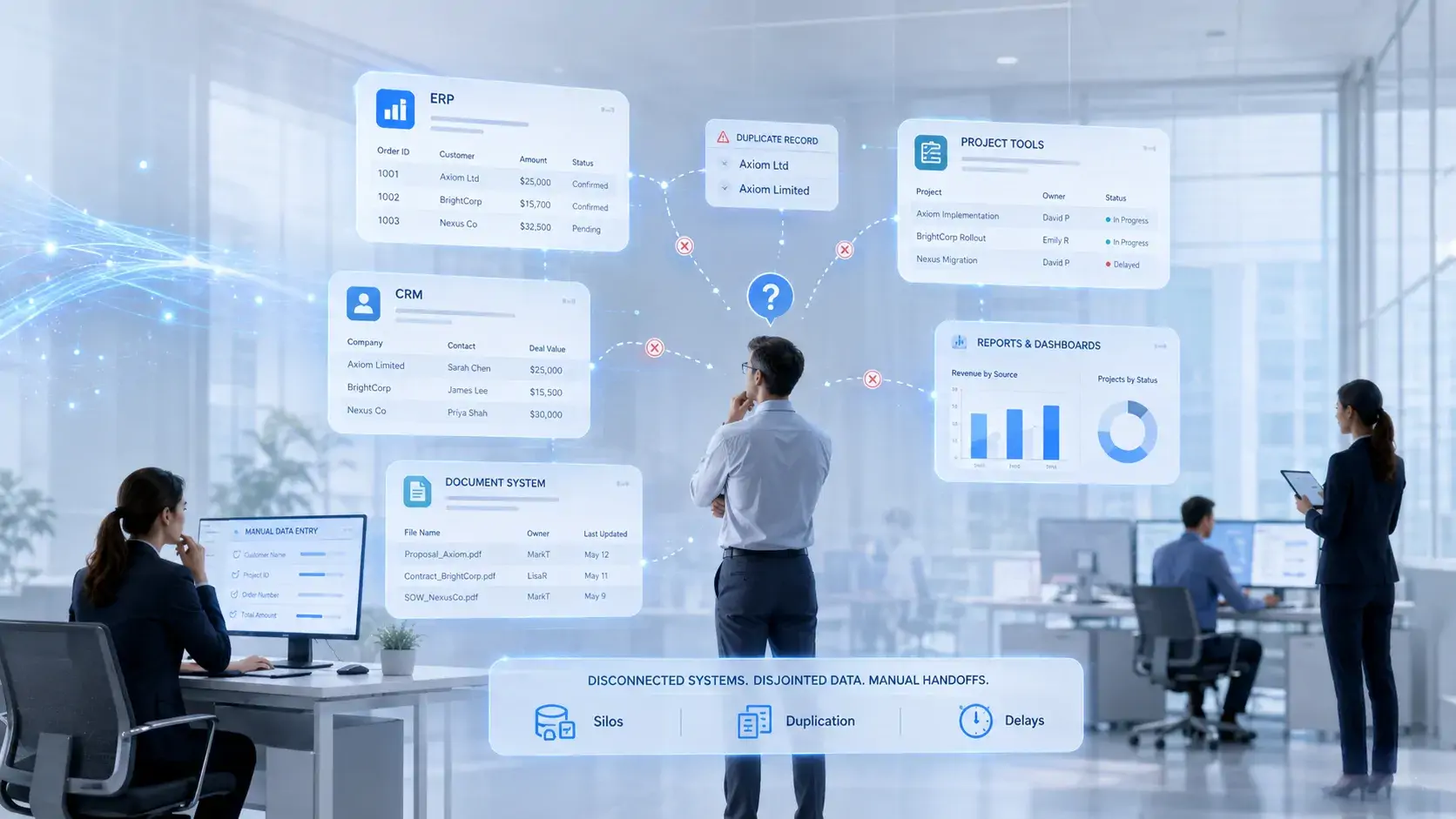
ERP, CRM, project platforms, document repositories and internal applications often hold different parts of the same business context. Each platform may perform its intended role effectively while the end-to-end process remains fragmented. [1]
The friction appears at the handoffs. Invoice information may be entered twice. Project updates may be consolidated manually. Reports may depend on several sources, while teams move between dashboards to reconstruct a current view. Overlapping records can also make it difficult to know which system contains the authoritative information.
This is where enterprise data management becomes essential. Your organisation needs clear ownership of critical data, consistent validation and update rules, and the right context to move with information across systems. [2]
Without those rules, connectivity can simply transfer inconsistent information faster. When systems are individually capable but the work between them remains manual, adding another application rarely solves the underlying problem.
System integration solutions help information, events and actions move between ERP, CRM, project platforms, document systems and internal applications. Instead of relying on employees to transfer information manually, an event in one system can support an update, review or action in another. [1][2]
Connect Enterprise Systems
Integration creates controlled connections between the systems already supporting day-to-day operations.
The goal is not to make every system dependent on every other system. It is to define where information must move, which application owns each part of the process and what should happen when a business event occurs.
Strengthen Enterprise Data Management
Reliable integration also supports enterprise data management. Data mappings, validation rules, ownership and update logic help determine how information should move and which version should be trusted. [2]
Once information has been validated, it can be reused across workflows instead of being recreated or reconciled repeatedly.
This matters because connecting systems without clarifying ownership can make data quality problems worse. If two applications maintain conflicting versions of the same record, the integration architecture must define which system is authoritative and how downstream systems should respond.[2]
Connect Workflows Across Operations
Connected context also makes operations management software more useful. Operational teams can receive information from surrounding systems without manually gathering it before making a decision.
An action in one application can trigger the next appropriate step elsewhere. The value is reducing the handoffs and repeated coordination that interrupt end-to-end workflows.
Integrate AI into Existing Enterprise Workflows
AI introduces another integration requirement. For AI to become operationally useful, it needs governed access to relevant enterprise context and a controlled path for returning outputs into existing workflows.[4]
A well-designed integration layer can provide that connection while keeping critical approvals, unusual exceptions and low-confidence outputs subject to appropriate human review.[4]
Good integration does not simply make applications communicate. It helps work move across them with the right information, context and controls.
Two organisations can use the same ERP, CRM or project platform and still need very different integrations. Data structures, ownership, approval thresholds, user roles, security requirements, exception paths and AI requirements may all differ. [3]
Technical Connectivity Is Not the Same as Operational Fit
A packaged connector may transfer information successfully between applications. But technical connectivity alone does not guarantee that the integration reflects how your organisation actually operates.
Integration consideration | Technical connectivity | Operational fit |
Data ownership | Moves records between systems | Defines which system owns the authoritative record |
Conflicting information | Transfers available data | Determines how conflicting records should be handled |
Missing information | Passes data when available | Defines validation, exception and escalation rules |
Approvals | Connects workflow steps | Preserves approval requirements based on business rules |
Human intervention | Enables automated data flow | Defines when a person must review or make a decision |
AI actions | Connects AI with enterprise applications | Controls what AI can access, recommend or act on |
Workflow context | Links applications technically | Reflects real dependencies between systems, teams and processes |
This is where enterprise data management becomes part of integration architecture rather than a separate concern. Data ownership, validation and exception handling determine whether connected information can actually be trusted and used. [2]
The same applies to operations management software. A system can be technically connected while remaining operationally weak if it does not receive the right context or reflect real workflow dependencies.
Effective integration therefore needs to address both sides: can the systems connect, and does that connection fit the way the business operates?
Tailor Integration Around Business Rules and Control
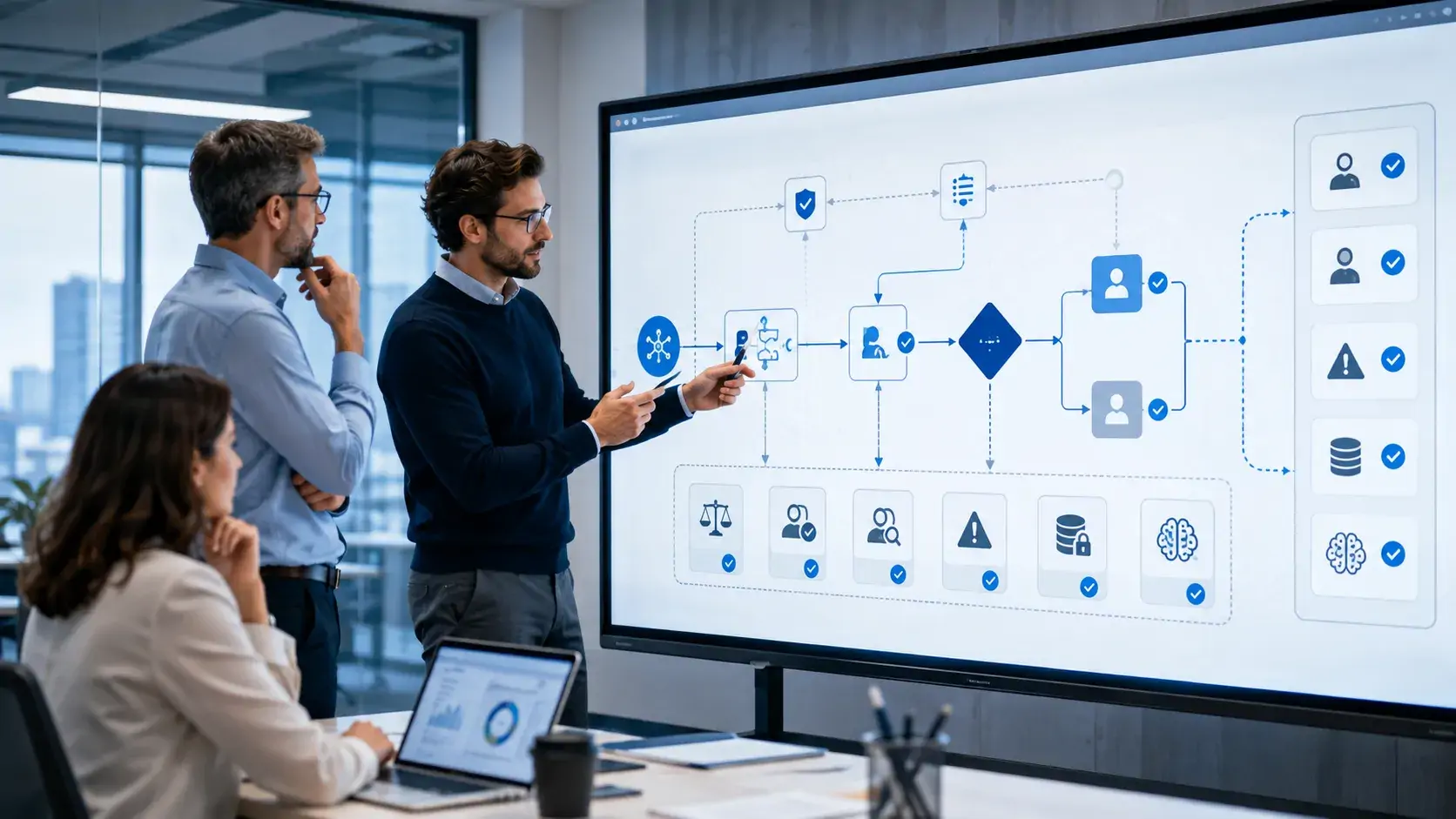
Effective system integration solutions should fit the way your organisation already operates, rather than forcing existing processes into a standard integration model.
This matters because enterprise workflows are rarely identical. Data ownership, approval rules, exception paths, security requirements and human decision points vary across organisations, even when they use the same ERP, CRM or project platforms.
A tailored approach allows integration to work around those differences. Core systems that already perform well can remain in place, while the connections between them are designed to reduce manual effort, improve data flow and preserve the controls the business still needs.
This is where KPS takes a different approach from fixed, one-size-fits-all solutions. KPS Enterprise Solutions are designed around existing systems, workflows and business rules, with integration and customisation considered together rather than as separate stages. [3]
KPS Enterprise Solutions are designed around the systems, workflows and business rules already in place. The focus is not simply connecting applications, but making those connections fit real data ownership, validation requirements, workflow dependencies and human control points. [3][4]
This matters when enterprise data management and operational workflows span multiple platforms. Instead of introducing another silo, KPS can extend existing environments with capabilities such as Document Intelligence for document-driven workflows [5] or LLM Security Gateway & Chat Hub where AI needs controlled access to enterprise information. [4]
The key value is operational fit: integration should improve how information moves through the business without forcing teams into a fixed workflow or unnecessary system replacement. [3]
What to Look for in an Integration Partner
A strong integration partner should understand your existing architecture and operating model before recommending technology. Look for the ability to:
map data ownership and system dependencies;
tailor integration to business rules and workflows;
manage exceptions and human review;
preserve working core systems where appropriate; and
support the solution beyond initial deployment.
For enterprise data management, this means establishing clear ownership and update rules. For operations management software, it means ensuring the right context reaches users even when information comes from several upstream systems.
Relevant KPS case studies can provide additional context on how tailored solutions are applied to real operational environments. [6]
Your organisation may not need another standalone tool. The better starting point may be a workflow where existing systems create unnecessary manual work between them.
System integration solutions can connect enterprise data, workflows, operations management software and AI while preserving established core platforms.
When integration reflects real business rules, enterprise data management becomes more reliable and operational workflows become easier to manage.
KPS can help identify the systems, data dependencies and integration points behind that friction, then design a tailored approach around how your organisation already operates. [3][4]
Do System Integration Solutions Require Replacing ERP or CRM?
No. System integration solutions can connect and extend existing ERP, CRM and other core platforms. Replacement is only necessary when a current system no longer meets business, security or scalability needs. [1]
How Does System Integration Support Enterprise Data Management?
Integration supports enterprise data management by defining how data is mapped, validated, updated and shared across systems, helping maintain clearer ownership and a trusted source of information. [2]
Can AI Work with Existing Operations Management Software?
Yes. AI can connect with operations management software through controlled integration, with clear rules for data access, outputs and human review. [4]
What Happens When Integrated Systems Receive Incorrect Data?
Reliable integration should validate data before it moves downstream. Missing or conflicting information can be routed for review instead of spreading errors across connected workflows.
What Is a Good First System Integration Use Case?
Start with a workflow that has high manual effort, multiple system handoffs and measurable outcomes, such as invoice processing, document intake or project reporting.
References
[1] McKinsey & Company — Enterprise Architecture & Digital Platforms.
[2] McKinsey & Company — How to Build a Data Architecture to Drive Innovation—Today and Tomorrow.
[3] Kensington Park Solutions — About Us.
[4] Kensington Park Solutions — AI Solutions.
[5] Kensington Park Solutions — Document Intelligence.
[6] Kensington Park Solutions — Centralized Healthcare Data Platform for Multi-Clinic Operations.


Table of content

Related Insights
Employee Training and Development for Workforce Capability
Explore how enterprises can connect employee training, coaching and skills development to build workforce capability at scale....

AI in Physical Security: Smarter Security for Australian Enterprises
Explore how AI in physical security transforms CCTV into intelligent monitoring with real-time threat detection, video analytics and smarter security for Australian enterprises....

Digital Education Transformation for Scalable Education Delivery
Explore how digital education transformation helps education and training providers connect learning, operations, compliance and data for scalable delivery....

Let’s build what’s next for your business
Tell us about your business challenges, we’ll help you shape the right solution.

