
Integrated Health Systems: Connecting Patient Data Across Clinical Networks

Jun 19, 2026



Healthcare providers often manage patient records, pathology results, prescriptions and referrals across separate digital systems. According to Australia's Productivity Commission, patient data remains fragmented across different systems maintained by individual healthcare providers. [1]
This creates a challenge when patients receive care from multiple providers. Relevant information may exist, but it is not always easy to access or share across different care settings.
Integrated health systems help address this gap by connecting patient information and healthcare workflows, allowing authorised teams to access relevant data when they need it.

When healthcare providers cannot easily access information from one another, patient care and daily operations can become less efficient. The Productivity Commission estimated that better use of electronic medical record data could reduce duplicated tests by up to AU$355 million annually across Australia's public hospital system. [1]
Effective integration can help healthcare organisations:
Reduce duplicate tests: Improve access to existing patient records and diagnostic results.
Improve care coordination: Make relevant patient information easier to share between GPs, specialists, hospitals and pharmacies.
Support clinical decisions: Give healthcare professionals a more complete view of relevant patient information.
Reduce administrative work: Minimise repeated data collection and manual information transfers between services.
The goal is to make relevant information accessible across care settings without requiring every provider to replace their existing systems.
A clinical integration network connects healthcare systems so patient information can be shared between providers and services. The systems involved depend on the organisation's care model and existing technology infrastructure.
Healthcare System | Information to Exchange | Purpose |
EHR and EMR systems | Medical history, medications and allergies | Provide relevant patient information |
Pathology and imaging systems | Test results and diagnostic reports | Support clinical assessment and follow-up |
Pharmacy systems | Prescriptions and dispensing information | Coordinate medication management |
Referral and hospital systems | Referral details, discharge summaries and care plans | Maintain continuity of care |
Patient portals and virtual care systems | Consultation notes and patient updates | Keep patients and care teams connected |

Not every organisation needs all these connections. For example, a multi-clinic provider may prioritise patient records, appointment information and clinic operations, while a virtual care provider may focus on consultations, prescriptions and follow-up.
A well-designed clinical integration network should therefore start with the information each team needs to deliver its services, rather than connecting systems without a clear operational purpose.
Connecting systems is only one part of the process. Healthcare data integration must also address three important challenges:
Patient identity and data quality. Patient records must be matched correctly across systems. Inconsistent personal details, duplicate records or incomplete information can affect the accuracy of shared data. [3]
Different data formats and standards. Healthcare systems may store or structure similar information differently. HL7 FHIR provides a standard for exchanging electronic healthcare information, while Australian implementations must also consider relevant national standards and conformance requirements. [4][5]
Privacy and access management. Patient information must only be available to authorised users. Organisations also need appropriate access permissions, data protection measures and audit processes to maintain control over sensitive information.

Addressing these challenges requires a structured approach to data management. A platform such as KPS Data Platform can support this by integrating information from different applications, databases and third-party systems, then improving data consistency through cleansing, filtering and normalisation. It also provides role-based access controls, encryption and auditing to support data governance.
These capabilities help create a more consistent and controlled data environment. However, specific clinical interfaces, patient-matching requirements and standards such as HL7 FHIR still need to be assessed based on each organisation's systems.
A practical implementation should begin with a specific operational need rather than attempting to connect every system at once.
Identify the priority workflow. Determine where disconnected information creates delays or manual work, such as referral management or test-result follow-ups.
Map existing systems and data. Identify where information originates, which systems need access and who is authorised to use it.
Select suitable integration methods. Assess existing interfaces, APIs, data formats and relevant standards, including FHIR where appropriate.
Establish data and access controls. Define validation rules, patient-matching procedures, access permissions and audit requirements.
Test the complete workflow. Confirm that information reaches the correct destination, remains accurate and can be used by the intended team.
For a clinical integration network, success should be measured by operational improvements, such as reduced manual data entry, faster access to patient information and more reliable follow-up—not simply the number of connected systems. [1][2]
Through the KPS Integrated Healthcare Platform (IHP), KPS helps connect clinical operations, patient applications and pharmacy services within a unified care workflow. KPS has also demonstrated its data integration capabilities through a project for a healthcare provider operating multiple clinics.
The provider struggled to manage patient records, appointments, CRM, POS and clinic operations across separate systems. KPS developed a centralised healthcare data platform to bring these systems together, supported by AI-powered tools for appointment bookings and common patient enquiries, as well as dashboards to monitor performance across branches.
The solution helped reduce manual administrative work, improve operational visibility and support more informed, data-driven decisions. Read the case study on healthcare data integration for multi-clinic operations to learn more.
Integrated health systems help healthcare providers make patient information more accessible, improve coordination across care settings and reduce disconnected workflows. However, successful integration requires more than connecting systems. Data must be accurate, secure and available where healthcare teams need it.
With solutions such as KPS Integrated Healthcare Platform (IHP) and experience in healthcare data integration, KPS helps organisations build connected workflows that support better patient care and operational efficiency.
Explore KPS Integrated Healthcare Platform (IHP) to discover how KPS can help connect your healthcare operations.
What is an integrated health system?
An integrated health system connects relevant patient information and healthcare workflows across multiple systems or providers. It helps authorised healthcare teams access the information they need to support coordinated care.
What is the role of a clinical integration network?
A clinical integration network enables healthcare systems to exchange information across providers, such as GPs, hospitals, specialists and pharmacies. Its scope depends on the organisation's care model and integration requirements.
What are the main challenges of healthcare data integration?
The main challenges include patient record matching, inconsistent data formats, system compatibility, data quality, privacy and access management.
Does healthcare data integration require replacing existing systems?
Not necessarily. Existing systems may be connected through suitable interfaces or APIs. The approach depends on system compatibility, data requirements and security controls.
What systems can an integrated healthcare platform connect?
An integrated healthcare platform can connect clinical operations, patient applications and pharmacy services. KPS IHP brings these functions together to support a more connected patient journey, from consultation and prescription management to medication fulfilment and follow-up.
References
[1] Australian Productivity Commission. Leveraging Digital Technology in Healthcare
[2] CSIRO. Unlocking Interoperability: The Key to Seamless Health Data Exchange
[3] ONC. Patient Identity and Patient Record Matching
[4] HL7. FHIR Overview
[5] Australian Digital Health Agency. Interoperability


Table of content

Related Insights
Employee Training and Development for Workforce Capability
Explore how enterprises can connect employee training, coaching and skills development to build workforce capability at scale....
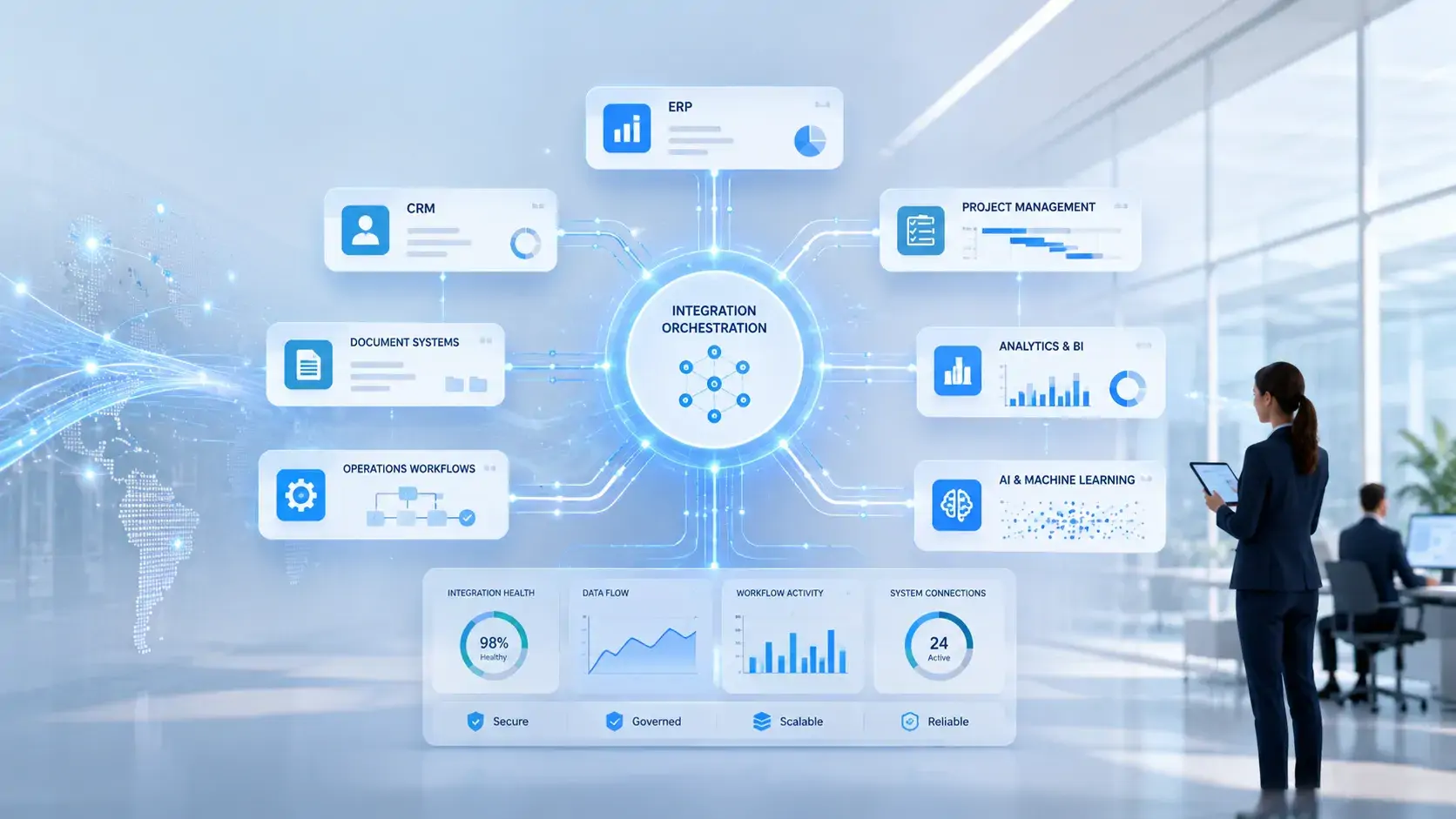
System Integration Solutions for Connected Operations
Discover how system integration solutions connect enterprise data, workflows and AI with existing systems to reduce fragmentation and improve operational visibility....

AI in Physical Security: Smarter Security for Australian Enterprises
Explore how AI in physical security transforms CCTV into intelligent monitoring with real-time threat detection, video analytics and smarter security for Australian enterprises....

Let’s build what’s next for your business
Tell us about your business challenges, we’ll help you shape the right solution.

