
Enterprise Data Architecture: A Practical Guide for Australian Organisations

Nov 16, 2026



Enterprise data becomes harder to manage as systems, standards and ownership evolve independently. Across legacy applications, cloud environments and data platforms, this fragmentation can increase the effort required to integrate, govern and deliver reliable data for business use.
The pressure is growing as organisations introduce new analytics and AI workloads. In 2025, 88% of organisations surveyed by McKinsey reported regular AI use in at least one business function, while only 7% had fully scaled AI across the organisation [1].
Enterprise Data Architecture (EDA) provides a common direction for how data is connected, governed, protected and used. This guide explains how Australian organisations can develop a practical EDA strategy and translate it into appropriate technology choices.
Enterprise Data Architecture is the organisation-wide blueprint for managing data throughout its lifecycle. It connects business requirements with decisions about data models, integration, storage, processing, governance, security and consumption.
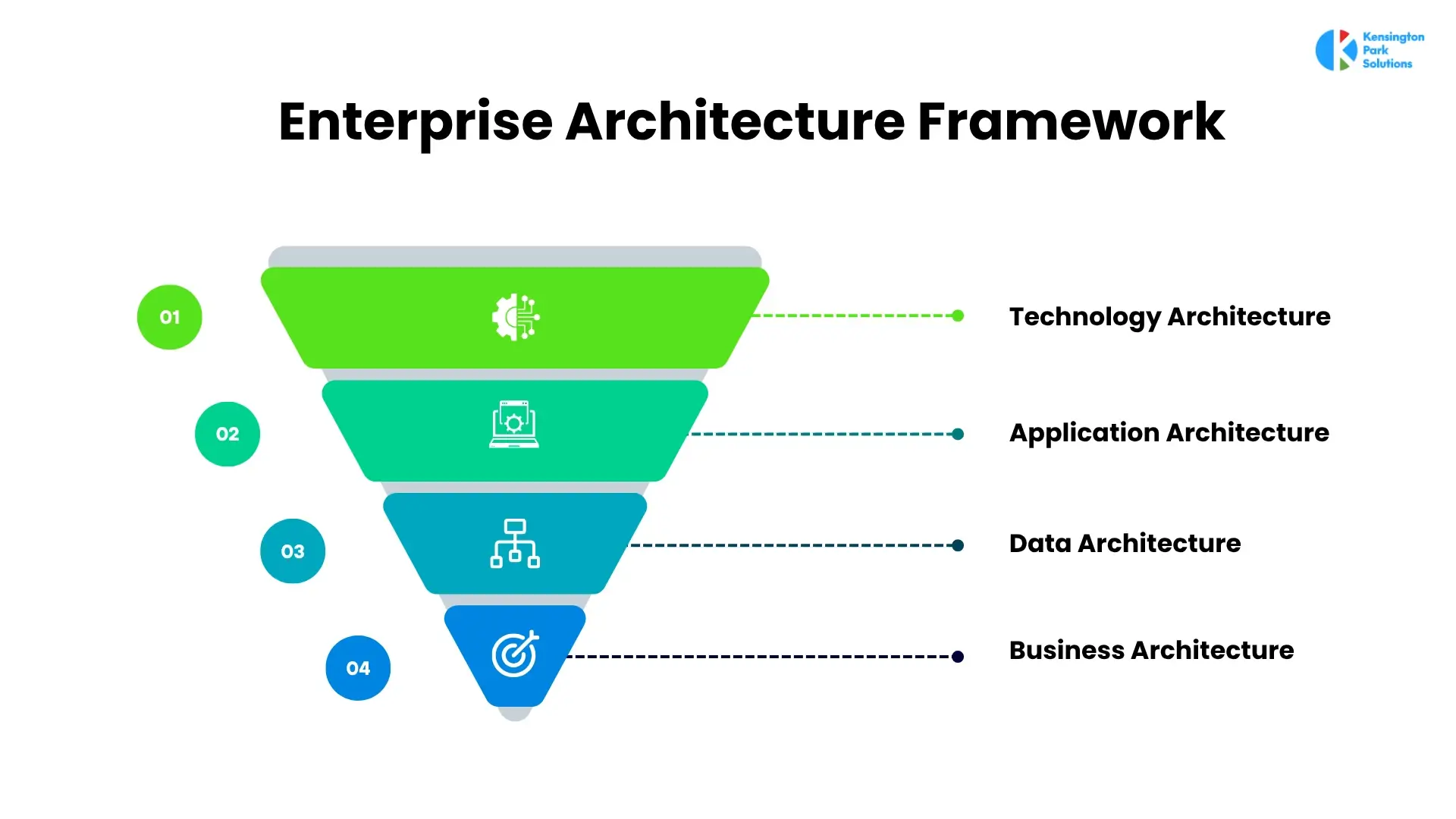
Unlike architecture created for an individual application, EDA considers the relationships between systems across the enterprise. It defines which data must be standardised, which systems remain authoritative, how information moves between environments and where different architectural approaches can coexist.
This distinction matters. Enterprise Data Architecture does not require every dataset to be centralised or every legacy system to be replaced. Its purpose is to create enough consistency for data to move reliably between operational systems, analytics platforms, cloud services and emerging AI workloads.
EDA becomes increasingly important when individual systems and data initiatives begin affecting the wider organisation. Instead of addressing each data requirement independently, it provides common principles for enterprise data management, including how data should be defined, connected, governed and reused.
Consistent Data Across Systems
Customer, product or operational data may be defined differently across CRM, ERP and other business systems. EDA establishes common definitions, ownership and integration rules so organisations know which sources are authoritative and how data should be shared across systems.
This does not mean creating one central copy of every dataset. The objective is to create consistency where it matters while allowing different systems to continue serving their intended business functions.
Governance Built into the Architecture
Effective enterprise data management requires organisations to consider where data is stored, who can access it, how long it is retained and how it moves between systems or jurisdictions. EDA brings these governance requirements into architecture decisions rather than applying them after systems have already been implemented.
For Australian organisations subject to the Privacy Act, this can include considering the Australian Privacy Principles when designing data flows and controls. APP 8, for example, is relevant where personal information is disclosed to overseas recipients, making cross-border data movement an architecture consideration when evaluating cloud services and external providers [2].
Data Ready for Analytics and AI
AI readiness is not simply about collecting more data. Analytics and AI applications need data that can be discovered, accessed, interpreted and governed appropriately.
EDA provides the architectural foundation for capabilities such as metadata, data quality, lineage, access controls and integration. These capabilities help organisations make reliable data available for analytics and AI without creating separate data environments for every new use case.
Reduced Integration Complexity
Point-to-point integrations may be manageable when only a small number of systems need to exchange data. As the environment grows, separate connections, transformations and business rules can become increasingly difficult to maintain.
EDA establishes reusable integration patterns and standards, such as APIs, event-driven integration and managed data pipelines, so new initiatives can build on shared capabilities rather than recreating the integration layer each time.
A practical EDA strategy does not begin by selecting a cloud platform. It begins with the business capabilities the architecture must support.
1. Align Architecture with Business Priorities
Start with outcomes such as enterprise reporting, integrated operations, customer analytics, regulatory reporting, process automation or AI.
These priorities determine which information must become available and reliable first. Architecture decisions can then be assessed against business value rather than technical preference.
2. Assess the Current Data Environment
Map major applications, databases, integrations, reporting platforms and data owners. Look specifically for duplicated datasets, conflicting definitions, manual reconciliation, fragile interfaces and workloads constrained by existing infrastructure.
The objective is not to identify everything that should be replaced. Systems that continue to perform important operational functions may remain part of the future architecture.
3. Define the Target Architecture
The target state should establish principles for:
data ownership and authoritative sources;
ingestion and integration;
storage and processing;
metadata, lineage and quality;
security and access;
analytics and AI consumption; and
cloud, on-premises and hybrid deployment.
For example, operational systems may remain on-premises while analytical workloads move into cloud services. EDA defines how information moves between those environments and where responsibility for the data sits.
4. Build Governance, Privacy and Security into the Design
Classify data according to sensitivity and business purpose before determining how broadly it should be shared. Architecture should then translate enterprise data management and governance requirements into practical controls: role-based access, encryption, auditability, retention rules, data lineage and appropriate deployment boundaries.
This reduces the risk of discovering late in implementation that a technically convenient architecture conflicts with privacy, security or regulatory requirements.
5. Modernise in Stages
Use priority business cases to move progressively towards the target architecture rather than attempting a big-bang transformation. A reporting initiative, for example, can introduce reusable integration or governance capabilities that later support analytics, automation or AI.
The objective is to ensure each initiative contributes to the wider architecture rather than becoming another isolated solution.
Once the architecture is clear, organisations can evaluate the technology model that best supports it. There is no universal requirement to adopt a data lakehouse, data mesh or entirely new cloud platform.
Approach | Best suited to | Key consideration |
Centralised warehouse or lakehouse | Shared analytics and controlled enterprise datasets | Strong consistency, but central teams can become bottlenecks |
Domain-oriented data mesh | Large organisations with mature domain ownership | Greater autonomy, but requires strong federated governance |
Hybrid architecture | Organisations retaining significant legacy or on-premises workloads | Reduces forced migration but requires disciplined integration |
AWS describes data mesh around domain ownership, data-as-a-product, self-service capabilities and federated governance [3]. A lakehouse, by comparison, combines characteristics of data lakes and data warehouses to support structured and unstructured data alongside analytics and machine-learning workloads [4].
These are implementation patterns, not the enterprise architecture itself.
The architecture defines how enterprise data should work; the platform provides technology capabilities that implement part of that architecture.
KPS's Data Platform, for example, supports integration with enterprise applications and major cloud environments, alongside data processing, analytics, security and governance capabilities across cloud, on-premises and edge deployment models. Such capabilities should be selected where they fit the target architecture rather than forcing the architecture around a predefined product.
Enterprise Data Architecture is not a one-time technology blueprint. Business priorities change, platforms evolve and new workloads place different demands on enterprise data. A useful architecture therefore establishes durable principles-ownership, interoperability, governance and security, while allowing the underlying technologies to change.
For Australian organisations, that approach creates room to modernise progressively without turning every new analytics, cloud or AI initiative into another isolated technology stack. KPS works with organisations to assess these requirements, define fit-for-purpose architectures and integrate data technologies around existing business and technology environments rather than applying a one-size-fits-all platform.
1. How does Enterprise Data Architecture support AI?
EDA gives AI systems more reliable access to governed data by defining data ownership, quality, integration, metadata, lineage and access controls. This helps prevent AI initiatives from depending on isolated or inconsistently defined datasets.
2. Which privacy requirements should Australian organisations consider?
Organisations should assess applicable Australian Privacy Principles, including requirements affecting data security and overseas disclosure. Additional obligations such as GDPR may apply where an organisation processes personal data covered by overseas regulations.
3. How should organisations evaluate an Enterprise Data Architecture partner?
Evaluate whether the partner can connect business requirements to architecture decisions, work with existing systems, explain technology trade-offs, incorporate governance and security, and support phased modernisation. Vendor-specific expertise alone is insufficient if the architecture becomes dependent on one product.
[1] McKinsey & Company — The State of AI in 2025: Agents, Innovation, and Transformation, 2025.
[2] Office of the Australian Information Commissioner — Chapter 8: APP 8 Cross-border Disclosure of Personal Information, updated 3 October 2025.
[3] Amazon Web Services — Strategies for Building a Data Mesh-Based Enterprise Solution on AWS.
[4] Microsoft Learn — What Is a Data Lakehouse?, Azure Databricks documentation.


Table of content

Related Insights

Enterprise Data Management: Building a Unified Data Foundation
Discover how enterprise data management helps organisations connect fragmented data, build a unified data foundation, and support better business decisions....

How to Choose an Enterprise Data Platform That Fits Your Business
Explore how enterprises can choose a data platform that fits industry requirements, existing infrastructure, and business needs while supporting faster deployment....

AI Process Automation for Australian Enterprises: Key Use Cases
Explore key AI process automation use cases for Australian enterprises and how AI can streamline operations, improve productivity, and scale business processes. ...

Let’s build what’s next for your business
Tell us about your business challenges, we’ll help you shape the right solution.

