
AI Process Automation for Australian Enterprises: Use Cases & Implementation

Jun 19, 2026



Australian enterprises are under increasing pressure to improve productivity without simply adding more people or more disconnected software. Labour costs reached AUD 410.4 billion in the December quarter of 2025, up 1.1% from the previous quarter.[1]
The Australia’s Generative AI Opportunity report estimates that generative AI could create AUD 30–80 billion annually through automation, AUD 10–25 billion through workforce augmentation, and another AUD 5–10 billion through new products, services and business models. It could also automate or augment around 44% of working hours across the Australian workforce.[2]
This shifts the enterprise AI conversation from what AI can generate to how it can reshape real business processes. This article explores how AI process automation works, where it can create the most value across Australian industries, and how enterprises can integrate it into existing workflows and systems.
AI process automation uses AI within business workflows to automate tasks that require more than fixed rules, such as interpreting documents, analysing information, detecting exceptions or determining the next action.
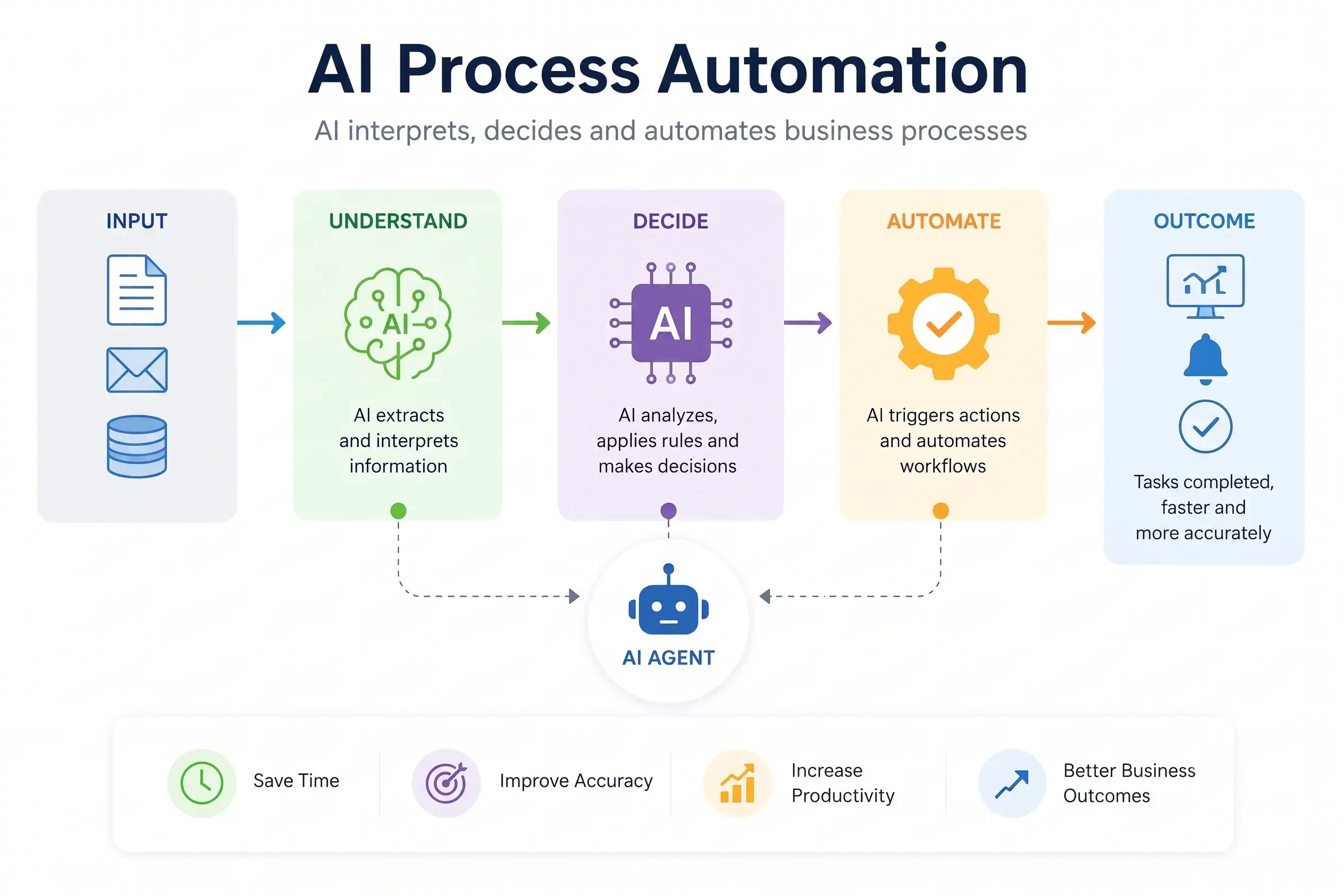
For example, instead of simply transferring invoice data into an ERP, an AI-enabled workflow can interpret different invoice formats, validate information against purchase orders and route exceptions automatically.
AI Process Automation vs Traditional Automation
Traditional automation | AI process automation |
Rule and workflow driven | AI and workflow driven |
Works best with structured inputs | Handles structured and unstructured information |
Executes predefined actions | Interprets, predicts and recommends actions |
Limited adaptability | Can respond to changing patterns and context |
Best for stable, repetitive tasks | Suitable for more complex knowledge-based processes |
In practice, the two often work together: conventional automation executes predictable steps, while AI handles the interpretation and decision points that previously required human input.
The value of AI process automation depends on where AI can remove manual work, accelerate decisions and connect insights with existing business workflows. In Australia, some of the strongest opportunities are emerging across financial services, healthcare, retail and manufacturing, as well as customer-facing functions such as marketing and client engagement.
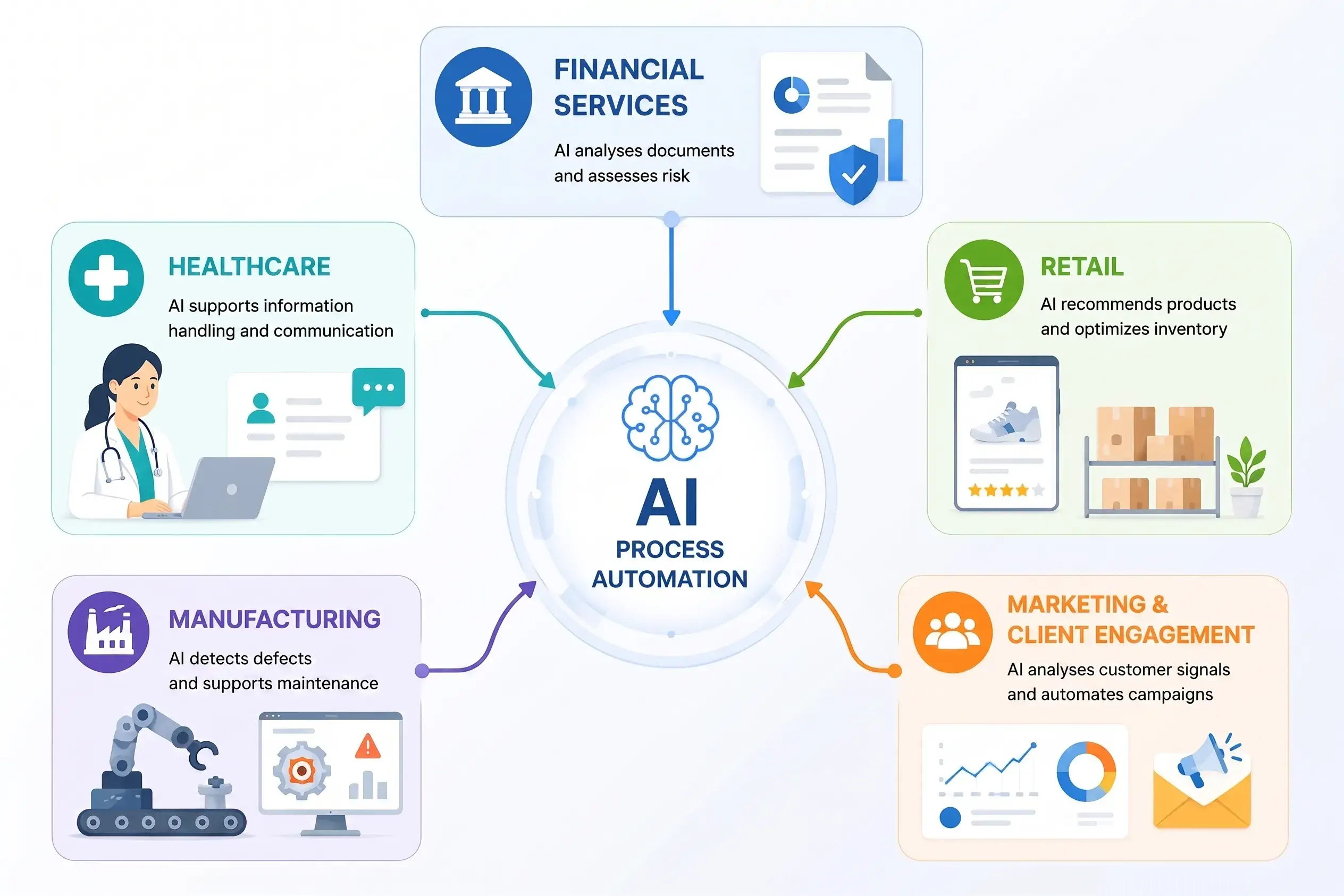
Financial Services
Financial services is particularly well suited to AI-enabled automation because many workflows involve large volumes of documents, complex decisions and strict regulatory requirements.
Risk Assessment & Underwriting Automation: AI can analyse hundreds of pages of financial statements, cash-flow data, credit histories and supporting documents to generate risk summaries for lending or insurance teams. This can reduce assessment cycles from several days to a few hours, while helping identify unusual risk indicators earlier.
Compliance & Regulatory Intelligence: AI can compare internal policies and processes against requirements from regulators such as ASIC and APRA, while supporting KYC and AML screening and flagging exceptions for review. Automating these repetitive checks can reduce human error and save thousands of hours of manual compliance and internal audit work.
Financial Advisor Co-pilot & Knowledge Retrieval: AI assistants can retrieve information across investment portfolios, tax policies, internal guidance and market developments to help advisers prepare for client meetings. Faster access to relevant knowledge allows advisers to support larger client portfolios while maintaining the quality and consistency of advice.
Marketing & Client Engagement
For marketing and customer-facing teams, AI process automation extends beyond content generation by connecting customer signals with campaign, sales and engagement workflows.
Hyper-Personalised Content Generation: AI can create nurture emails, newsletters and product recommendations based on customer profiles, spending behaviour, risk preferences or financial goals. This allows organisations to personalise engagement at scale without requiring content teams to create every variation manually.
Lead Scoring & Routing: AI can analyse interactions across websites, chatbots, forms and surveys to assess purchase intent and automatically route high-value opportunities to the most relevant sales or advisory team. This can reduce response times from hours to near real time, helping businesses act before potential opportunities are lost.
Campaign Workflow & Asset Automation: AI can generate A/B testing variations, supporting visuals and channel-specific content, while using campaign performance data to recommend adjustments. This can reduce marketing asset production time by 40–60%, allowing teams to focus more on positioning, growth strategy and optimisation.
Healthcare
In healthcare, one of the strongest opportunities is reducing the administrative burden on clinicians so more time can be directed towards patient care.
Ambient Clinical Documentation: With appropriate patient consent, AI can capture clinician-patient conversations and convert relevant information into structured clinical notes for review. This can save clinicians around 1–2 hours of documentation work per day, reducing administrative workload and helping address burnout.
Clinical Knowledge Retrieval: Healthcare professionals can use natural-language queries to retrieve treatment guidance, drug information and relevant medical literature from approved sources. This reduces time spent manually searching through large volumes of clinical information and supports faster access to up-to-date knowledge.
Patient Communication & Discharge Support: AI can convert complex medical terminology into clearer discharge instructions, medication guidance or multilingual communications. This can improve patient understanding and treatment adherence while reducing repetitive communication work for care teams.
Because these workflows involve sensitive information, privacy, access controls and appropriate human oversight need to be built into the automation process from the start.
Retail
Retail AI creates the most value when customer-facing intelligence is connected with merchandising, inventory and fulfilment workflows.
Conversational Shopping Assistants: AI agents can understand requests such as “I need an outfit for a beach wedding in Sydney under $200” and recommend suitable products based on context, preferences and budget. More relevant recommendations can help improve conversion and increase average order value.
Catalog & Merchandising Automation: AI can generate product descriptions, SEO attributes, tags and visual variations using existing product data. Automating these activities can reduce the time required to bring new products online from weeks to hours.
Dynamic Demand & Inventory Orchestration: AI can combine sales history with signals such as weather, regional demand and social trends to forecast demand and automatically trigger replenishment or stock-reallocation workflows. This helps retailers reduce excess inventory while limiting stock-outs during periods of high demand.
Manufacturing
For Australian manufacturers, where labour and operating costs are high, AI can create value by accelerating product development, reducing downtime and making specialist knowledge easier to access.
Generative Design & Prototyping: Engineers can define constraints such as material, weight, durability and cost, allowing AI to generate multiple design alternatives for evaluation. This can reduce prototyping time by 30–50% while helping optimise material use.
Field Technician Co-pilot: Technicians can use voice, text or image inputs to retrieve equipment manuals, circuit diagrams and maintenance procedures from thousands of pages of technical documentation. Faster access to the right information can improve first-time fix rates and reduce production downtime.
Safety & Incident Reporting: AI can consolidate technician statements, operational logs and sensor information into structured incident reports aligned with safety requirements. This reduces manual reporting effort and helps teams identify potential safety risks more quickly.
Across these industries, the value comes from more than deploying an AI model. AI needs to connect with enterprise data, operational systems, approval rules and human workflows so that insights can lead to controlled business action and scalable AI process automation across end-to-end processes.
Across these use cases, the value of AI process automation comes down to a few measurable enterprise outcomes.
Higher operational efficiency: Reduce manual work across document processing, knowledge retrieval and repetitive workflows.
Faster decisions: Bring relevant data, predictions and recommendations directly into the workflow.
Lower operating costs: Automate high-volume activities while allowing employees to focus on exceptions and higher-value work.
Greater scalability: Handle growing transaction volumes without increasing manual effort at the same rate.
Enterprises can measure impact through metrics such as processing time, cost per transaction, error or exception rates, response time and the percentage of work completed without manual intervention.
Achieving these outcomes depends on more than selecting a capable AI model. In practice, the performance of AI process automation is shaped by how well AI fits the surrounding data, systems, business rules and controls.
Get the foundations right: Even a strong AI model can underperform when data is inconsistent, integrations are unreliable or governance responsibilities are unclear.
Keep deterministic rules where they belong: AI is most useful for interpretation, prediction and decision support. Fixed rules should still govern approvals, compliance requirements and other critical controls where consistency is essential.
Design for change: Models, prompts, policies and enterprise systems will continue to evolve. Flexible architectures and modular integrations make it easier to update or scale automation without rebuilding entire workflows.
This is why implementation often becomes more important than model selection itself. To sustain efficiency, scalability and faster decision-making over time, AI needs to be integrated into existing workflows in a way that can adapt as business requirements change.
For Australian businesses looking for a trusted technology partner to implement AI process automation, KPS is one partner to consider. We tailor AI solutions to fit your existing workflows, systems and operational requirements rather than applying a one-size-fits-all approach.
At KPS, we bring practical experience in designing, integrating and applying AI solutions for Australian businesses across different operational environments.
One example is our work with a dementia care education provider that needed to make learning resources easier for caregivers and older learners to access. KPS developed an AI Learning Assistant combining conversational AI, voice interaction, RAG and personalised recommendations. Integrated into the existing learning environment, it helps users find relevant resources faster and navigate content more intuitively.
AI process automation is already being adopted across many industries, helping enterprises improve efficiency, reduce manual work and make faster decisions. Its impact is particularly relevant in sectors such as financial services, healthcare, retail and manufacturing, where complex workflows and large volumes of information create strong opportunities for automation. Explore how KPS AI solutions can help your business turn these opportunities into practical, integrated solutions.
What is AI process automation?
AI process automation combines AI with business workflows and systems to automate tasks that require interpretation, analysis or decision support—not just fixed rules.
Which processes should businesses automate with AI first?
Start with workflows that involve high volumes of repetitive work, manual information processing or frequent exceptions. Good candidates include document processing, knowledge retrieval, customer interactions, risk assessment and operational monitoring.
What should enterprises consider before implementing AI process automation?
Consider data readiness, existing system integrations, business rules, governance requirements and where human oversight is still required. The solution should also be flexible enough to adapt as models, workflows and business requirements change.
How long does AI process automation implementation take?
There is no fixed timeline. A focused use case can be implemented relatively quickly, while workflows involving multiple enterprise systems, sensitive data or complex governance typically require a phased approach.
How do you choose the right AI implementation partner?
Look for practical AI experience, strong integration capability and an ability to tailor solutions around your existing workflows and systems. The right partner should also consider governance, scalability and long-term maintainability - not just the initial AI deployment.
References
[1] Australian Bureau of Statistics — Labour Account Australia, December 2025.
[2] Tech Council of Australia & Microsoft — Australia’s Generative AI Opportunity, July 2023.


Table of content

Related Insights

Enterprise Data Management: Building a Unified Data Foundation
Discover how enterprise data management helps organisations connect fragmented data, build a unified data foundation, and support better business decisions....

How to Choose an Enterprise Data Platform That Fits Your Business
Explore how enterprises can choose a data platform that fits industry requirements, existing infrastructure, and business needs while supporting faster deployment....

Business Workflow Automation: From Documents to Faster Processes
See how business workflow automation turns document data into validated workflows with fewer manual steps, clearer exceptions and better integration....

Let’s build what’s next for your business
Tell us about your business challenges, we’ll help you shape the right solution.

