
Why Enterprise Data Management Is Becoming the Foundation for Data-Driven Enterprises

Jun 19, 2026



Australian enterprises manage vast volumes of operational records across ERP systems, CRM databases, legacy data warehouses, point-of-sale terminals, and IoT devices. However, collecting raw data does not create operational capability. According to Gartner, poor data quality and system fragmentation cost organisations an average of $12.9 million annually in lost productivity and compromised operational decisions [1]. The core issue is structural: critical business records remain isolated in separate environments without unified governance. To build reliable reporting and deploy artificial intelligence models, organisations require robust enterprise data management. Establishing an authoritative data foundation allows your engineering teams to connect distributed records and transform raw system inputs into usable assets.
Data fragmentation introduces direct friction into operational workflows. When business units operate on separate systems, enterprise data management breaks down, and teams end up relying on conflicting versions of critical business records. McKinsey reports that knowledge workers spend up to 30% of their working hours searching for, preparing, and reconciling fragmented operational data [2]. This manual consolidation slows operational response times and inflates engineering costs.

How Disconnected Systems Create Data Fragmentation
Large enterprises run core operations on separate, purpose-built platforms. Your enterprise resource planning (ERP) system records inventory and accounting, your customer relationship management (CRM) platform tracks sales pipelines, and operational databases store branch-level transactions. Because these applications use distinct schemas and proprietary storage models, they function as isolated repositories. Without unified enterprise information management, integrating these systems requires brittle point-to-point connections that increase technical debt.
Why Inconsistent Data Makes Reporting Harder
When systems store data in conflicting formats, aggregating operational metrics becomes a complex engineering challenge. A retail organisation, for instance, might record customer identifiers differently across point-of-sale registers, mobile applications, and web storefronts. Reconciling these variations requires extensive manual intervention. This friction delays monthly reporting cycles, increases calculation errors, and forces data engineering teams to spend time fixing broken pipelines rather than delivering analytics.
How Fragmented Data Limits Business Visibility
Executive leaders require immediate visibility over operations to make fast capital allocations. Disconnected environments prevent leaders from seeing unified inventory levels, real-time supply chain bottlenecks, or consolidated patient records across multi-clinic healthcare networks. When datasets contradict each other, leaders lose confidence in operational dashboards and must wait days for manual reconciliation.
| Dimension | Fragmented Data Environment | Unified Data Environment |
| Data sources | Disconnected databases, legacy ERP, and isolated applications | Connected real-time streams, APIs, and relational repositories |
| Data access | Restricted by department silos and custom access requests | Governed, role-based access for engineering and business teams |
| Data consistency | Conflicting definitions, duplicate records, and schema mismatches | Standardised business logic and validated schemas |
| Reporting | Delayed manual extractions and offline spreadsheet reconciliation | Automated, real-time dashboards and analytics feeds |
| Business visibility | Partial operational views with delayed decision cycles | Single source of truth with complete operational visibility |
| Operational effort | High engineering overhead spent on data maintenance and cleaning | Automated data pipelines that free teams for strategic execution |
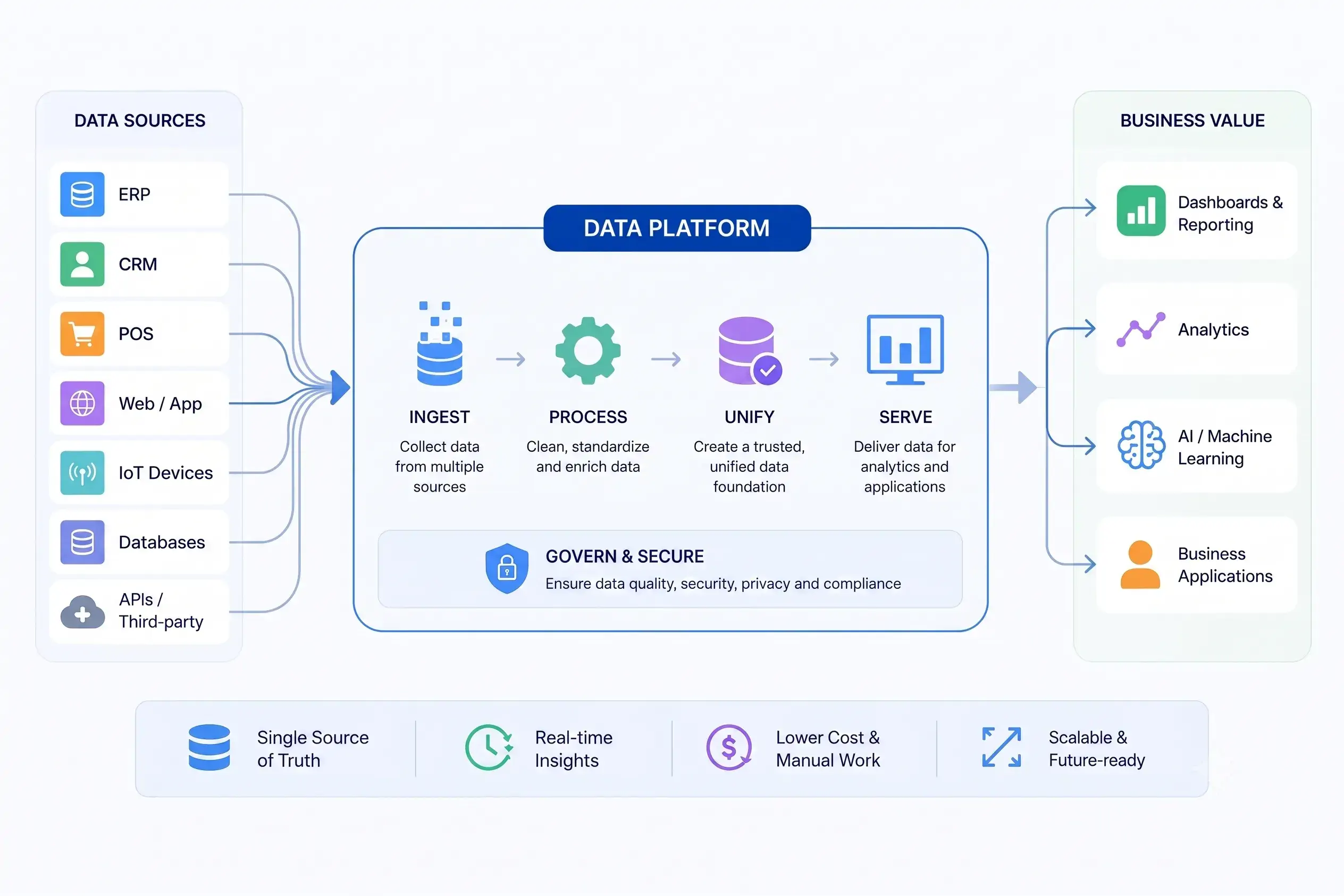
Building a unified data foundation does not require moving all corporate records into a single physical database. Instead, modern enterprise data architecture establishes an abstraction layer that connects, cleanses, standardises, and consolidates data across your existing estate. This systematic approach to enterprise information management converts raw operational inputs into trusted assets.
Connecting Data Across Enterprise Systems
A resilient enterprise data platform connects with over 40 enterprise systems, cloud storage services, and IoT protocols [3]. Connecting these sources through managed workflow orchestrators removes point-to-point interface dependencies. By streaming data directly from transaction databases, APIs, and file repositories, your infrastructure captures operational events in real time.
Standardising Data for Consistent Business Information
Raw records contain syntax errors, duplicate entries, and incomplete attributes. Effective enterprise data management pipelines automatically execute data cleansing, deduplication, schema validation, and attribute enrichment. Standardising business logic ensures that financial figures, inventory counts, and customer identities maintain identical definitions across every business unit.
Turning Unified Data into a More Usable Business Foundation
Standardised datasets form a definitive single source of truth. Business operations teams can query reliable inventory metrics, while clinical staff can pull consolidated medical records without manual data preparation. Establishing this trusted layer prepares your data infrastructure for advanced machine learning models and predictive operational analytics.
Enterprises with complex IT estates cannot afford multi-year digital replacement programs. A modern enterprise data platform must integrate directly with existing databases, cloud providers, and on-premises infrastructure. Implementing a modular enterprise data architecture allows you to adapt data governance and processing layers to your specific regulatory requirements.
Why Industry-Configured Foundations Can Accelerate Deployment
Building data pipelines from scratch increases delivery risk and extends deployment timelines. KPS Solutions uses industry-configured foundation modules configured for sectors such as retail, manufacturing, logistics, and healthcare. Starting with pre-built schema templates and data ingestion connectors shortens deployment cycles while allowing targeted customisation for your proprietary business logic.
Adapting the Platform to Existing Enterprise Infrastructure
Deployment models must respect infrastructure constraints and data sovereignty requirements. Australian organisations can deploy data foundations across three primary architectures:
On-Premise Infrastructure: Runs entirely within your corporate local area network (LAN) for strict security compliance, eliminating recurring cloud subscription fees.
Edge Computing (T-BOX): A standalone hardware unit that executes ingestion and local model processing directly at remote factories or retail branches, operating reliably in low-connectivity conditions.
Cloud Deployments: Scales on Microsoft Azure, AWS, or Google Cloud Platform (GCP) to deliver multi-region analytics with automated backup and disaster recovery.
Security frameworks must enforce ISO 27001 standards, end-to-end encryption, and role-based access control (such as DataEngineer, DataAnalyst, and PlatformAdmin roles) to protect sensitive records [4].
Scaling the Same Data Foundation Across Enterprise Environments
As your business expands into new markets or acquires operational units, your data platform must scale without requiring structural redesigns. An open architecture based on Data Fabric and Lakehouse standards prevents single-vendor lock-in, enabling you to add databases, change cloud hosts, or expand edge deployments seamlessly.
To explore practical enterprise data management implementations for your infrastructure, evaluate how the KPS Data Platform integrates distributed systems into a scalable, high-performance architecture.
Effective enterprise data management moves your organisation beyond isolated system maintenance and establishes an adaptable data foundation. When data grows across disconnected environments, attempting to solve reporting friction with ad-hoc spreadsheets increases technical debt. Instead, deploying a tailored enterprise data platform allows you to connect legacy systems, standardise inconsistent data formats, and establish an authoritative single source of truth.
Modernising your enterprise data architecture does not require an expensive or disruptive infrastructure overhaul. By applying pre-configured industry frameworks and adapting them to your on-premises, cloud, or edge environments, you gain immediate visibility into operational performance while preparing your systems for advanced AI capabilities.
What is enterprise data management?
Enterprise data management is the structured practice of collecting, integrating, standardising, and securing an organisation's data assets. It establishes clear governance and technical architecture so business units can access consistent, trusted operational information for daily reporting and strategic decision-making.
Why is enterprise data management important for large organisations?
Large organisations operate dozens of disconnected applications, creating data silos and reporting discrepancies. Enterprise data management unifies these fragmented sources into a single source of truth, cutting manual preparation costs, improving operational visibility, and providing clean datasets for analytics and automation.
What is an enterprise data platform?
An enterprise data platform is a unified software layer that automates data ingestion, cleansing, storage, and transformation across multiple business systems. It connects raw operational data from ERPs, CRMs, APIs, and edge devices to power dashboards, business intelligence tools, and machine learning models.
How can enterprises integrate data from different systems?
Enterprises integrate systems by establishing automated pipelines that extract raw records via APIs, direct database connectors, or messaging queues. The platform then cleanses, validates, and normalises this information against unified business models before loading it into a structured analytics repository.
How should organisations evaluate an enterprise data management partner?
Evaluate partners based on their engineering capability to customise solutions for your existing infrastructure rather than forcing proprietary product lock-in. A reliable partner demonstrates deep integration experience, provides flexible deployment options (cloud, on-premise, edge), and complies with ISO 27001 security standards.
References
[1] Gartner, Data Quality: Best Practices for Accurate Insights, Gartner Research, 2024.
[2] McKinsey & Company, The Social Economy: Unlocking Value and Productivity Through Social Technologies, McKinsey Global Institute, 2023.
[3] Harvard Business Review, From Operational Data Maintenance to Strategic Data Architecture: Master Data Management at Chr. Hansen, HBR Store, 2023.
[4] International Organization for Standardization, ISO/IEC 27001: Information Security Management Systems Requirements, ISO, 2022.
[5] Forbes Technology Council, How To Make Data Governance A Competitive Advantage, Forbes, 2026.


Table of content

Related Insights

How to Choose an Enterprise Data Platform That Fits Your Business
Explore how enterprises can choose a data platform that fits industry requirements, existing infrastructure, and business needs while supporting faster deployment....
AI Process Automation for Australian Enterprises: Key Use Cases
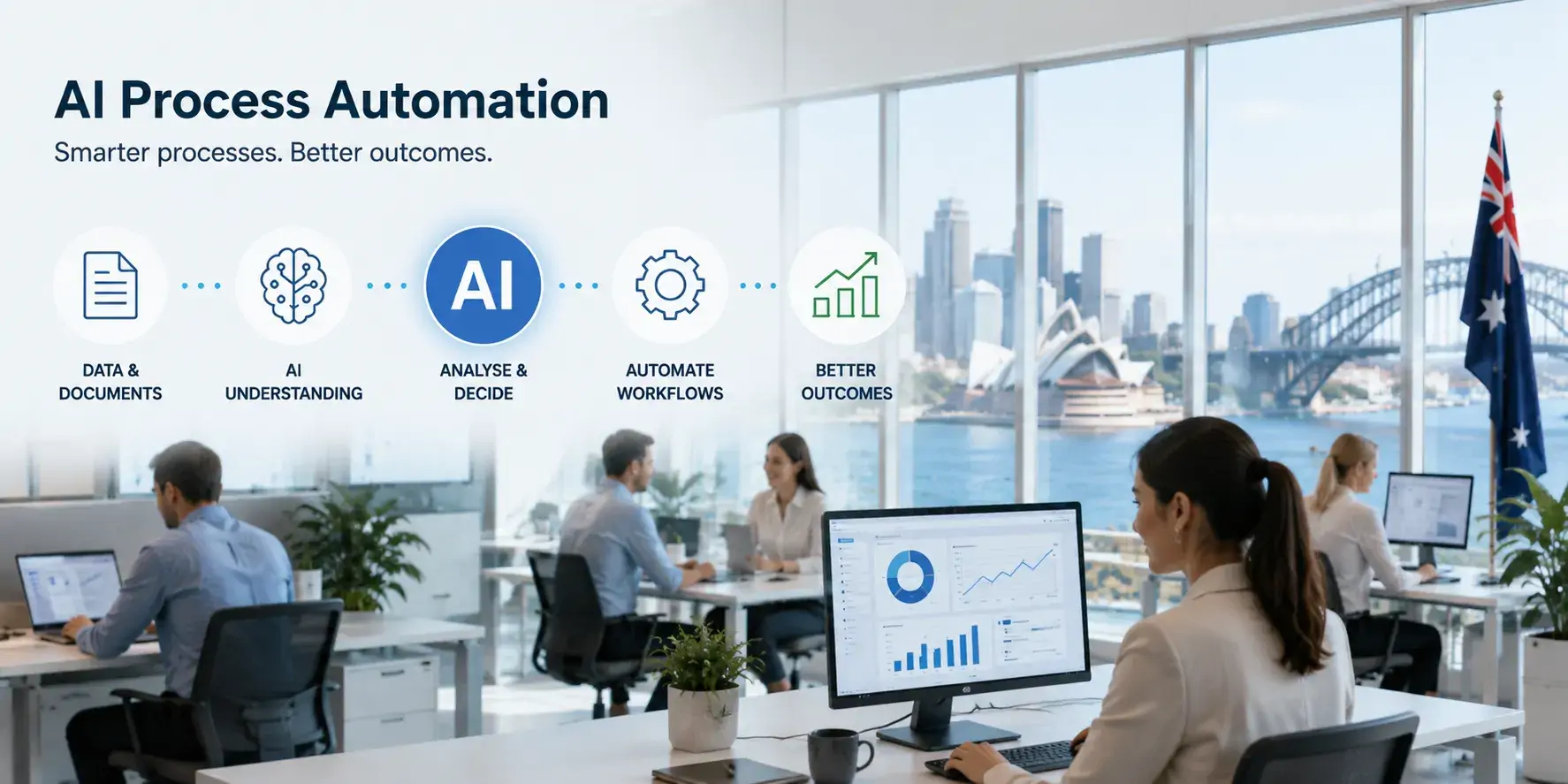
Explore key AI process automation use cases for Australian enterprises and how AI can streamline operations, improve productivity, and scale business processes. ...
Business Workflow Automation: From Documents to Faster Processes
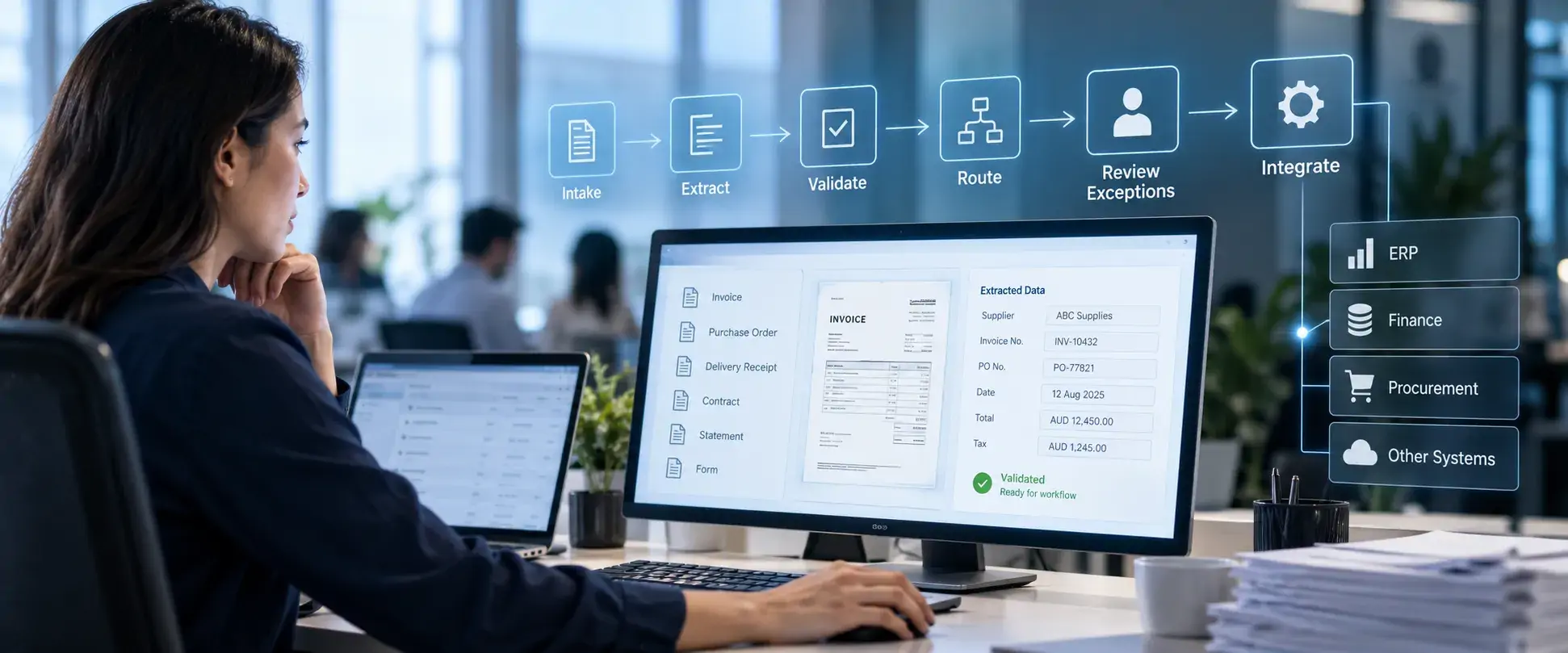
See how business workflow automation turns document data into validated workflows with fewer manual steps, clearer exceptions and better integration....

Let’s build what’s next for your business
Tell us about your business challenges, we’ll help you shape the right solution.

