
AI Sales Training Platform: How AI Coaching Supports Sales Readiness

Nov 19, 2026



Sales training is a significant investment, particularly for organisations managing large or geographically distributed teams. Coordinating training sessions, bringing sales representatives together and providing individual coaching require considerable time and resources. Yet completing training does not necessarily mean employees are ready for real customer conversations.
According to Salesforce's State of Sales, 7th Edition (2026), 41% of sales representatives reported insufficient opportunities to practise customer conversations through roleplay, while 46% rarely received feedback on their sales interactions.[1] An AI sales training platform helps address this gap by allowing representatives to practise independently, receive immediate feedback and develop practical selling skills without relying on scheduled coaching sessions. For organisations, it offers a more scalable way to deliver training and measure progress.
An AI sales training platform is a digital coaching solution that helps sales representatives develop practical selling skills through simulated customer conversations. Instead of relying solely on classroom training or product knowledge assessments, employees can practise responding to customer enquiries, handling objections and explaining products in a controlled environment.
The key difference is how sales readiness is assessed. Rather than measuring only what employees have learned, the platform evaluates how effectively they apply that knowledge during conversations. Training managers can use these assessments to identify skill gaps and direct further coaching towards areas requiring improvement.
An effective AI sales training platform should go beyond providing AI-generated conversations. Its training scenarios, feedback mechanisms and assessment criteria need to reflect actual sales processes and business requirements.
Realistic AI Roleplay
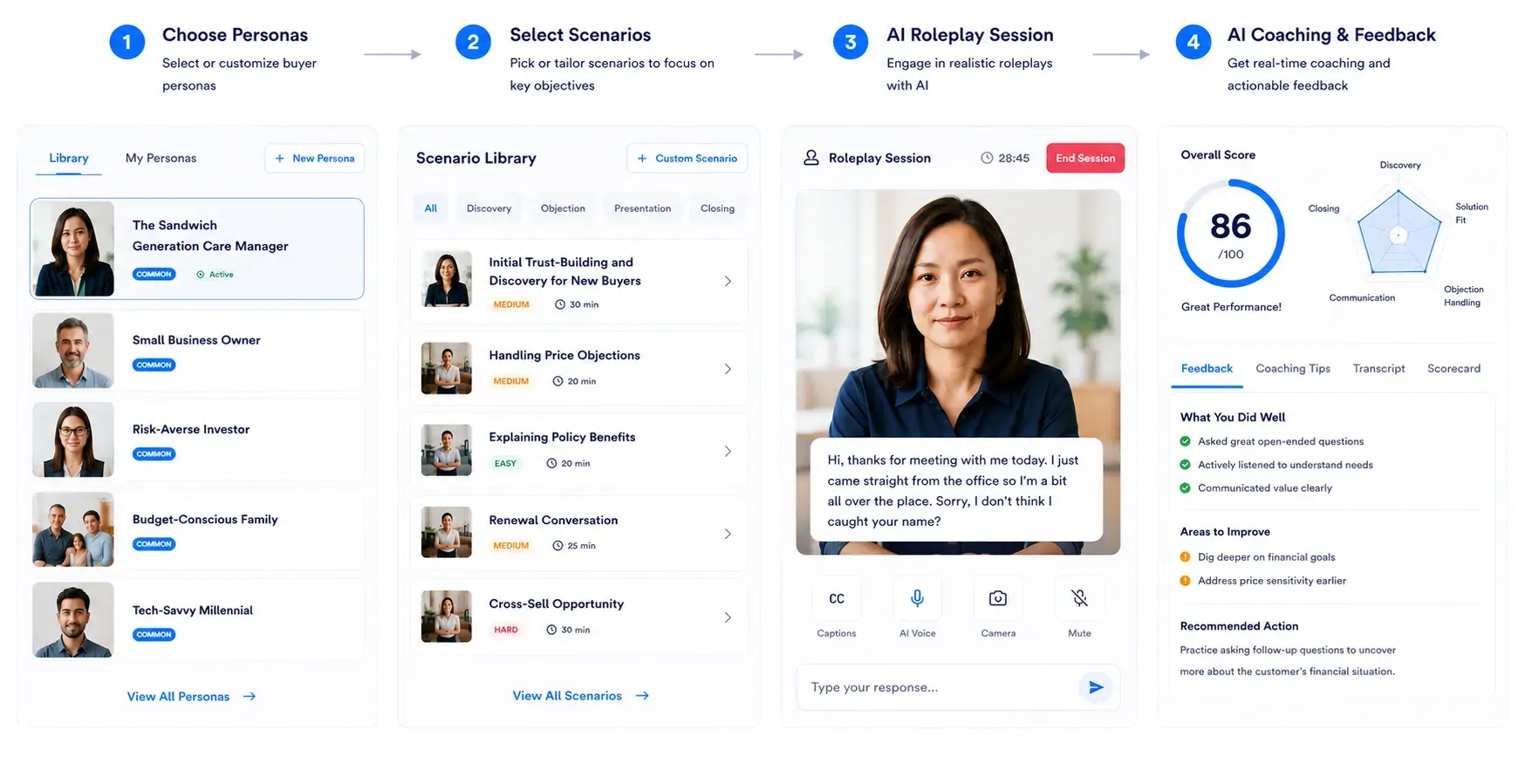
AI roleplay allows employees to interact with simulated customers representing different personalities, purchasing intentions and levels of product knowledge. The AI responds dynamically, adapting its questions and objections based on the representative's responses.
Training teams can configure scenarios around specific products, customer profiles and sales objectives. For example, an insurance agent might practise explaining policy exclusions to a price-sensitive customer, while a banking representative rehearses a loan consultation with a customer concerned about repayment costs.
Immediate Feedback and Performance Scoring
After each simulation, the AI coaching platform evaluates performance against predefined criteria, such as:
Product knowledge and information accuracy
Communication and needs assessment
Objection handling and negotiation
Compliance with sales guidelines
Conversation structure and closing techniques
Employees receive competency scores and feedback highlighting strengths, mistakes and opportunities for improvement. For training managers, consistent evaluation criteria can help identify recurring weaknesses across a sales team.
Personalised Learning Paths
Rather than assigning identical training activities to every employee, the platform can recommend further practice based on individual assessment results. For example, a representative who demonstrates strong product knowledge but struggles with objection handling can be assigned more challenging customer scenarios targeting that specific skill. Subsequent assessments help determine whether performance has improved or additional coaching is needed.
Skill-Gap Visibility for Sales Managers
The platform provides managers with a centralised dashboard to monitor training performance and skill development across individuals and teams. It consolidates assessment results, practice activity and competency progression, offering visibility into:
Individual and team performance
Recurring skill gaps across sales competencies
Training participation and completion
Skill development over time
Managers can review performance trends across employees, teams and branches to identify areas requiring further training or coaching.
For organisations, the value of an AI sales training platform extends beyond improving access to training. It can help address the operational costs of delivering coaching consistently across growing sales teams.
Salesforce reports that 40% of sales representatives consider their manager's lack of time an obstacle to enablement, while 52% believe traditional training materials do not provide the skills they need.[1] These findings highlight the importance of training approaches that combine independent practice with targeted human coaching.
Key business benefits include:
Reduced training coordination: Sales representatives can practise remotely and at their own pace, reducing dependence on centrally scheduled sessions.
More efficient use of coaching resources: Managers can focus on complex skill gaps rather than supervising every practice conversation.
Consistent assessment across teams: Standardised scenarios and scoring criteria support more comparable evaluations across branches and regions.
Earlier identification of skill gaps: Organisations can detect communication or compliance weaknesses before employees handle more complex customer interactions.
Measurable training progress: Repeated assessments provide evidence of skill development beyond attendance and course completion.
These benefits are particularly relevant for businesses with high onboarding volumes, distributed sales networks or frequent product updates.
Training effectiveness should not be measured by participation alone. Organisations need to understand whether the investment reduces training effort, improves employee capability and contributes to business outcomes.
A practical evaluation framework considers three levels:
Measurement area | Example KPIs | Business relevance |
Training efficiency | Trainer hours, training cost per employee, time to competency | Evaluate resource savings and training scalability |
Skill development | Competency scores, assessment pass rates, improvement across simulations | Measure whether representatives are developing required capabilities |
Business performance | Sales conversion, onboarding productivity, compliance incidents | Assess whether improved skills translate into operational results |
For example, an organisation can compare trainer hours and average competency scores before and after introducing AI-powered practice. It can then examine whether employees who demonstrate improved skills also achieve better outcomes in actual sales activities.
ROI should be assessed against a defined baseline, accounting for platform costs, implementation effort and ongoing training requirements. Improvements in simulation scores alone should not be treated as proof of increased sales revenue.
Sales training requirements vary according to product complexity, customer expectations and regulatory obligations. Industry-specific scenarios help organisations prepare representatives for conversations they are likely to encounter.
Insurance
Insurance agents need to explain policy coverage, exclusions and premium structures while addressing concerns about affordability and suitability.
Example scenario: A customer questions why a recommended policy costs more than a competing offer. The agent must clarify differences in coverage, explain relevant exclusions and respond without making unsupported promises.
AI roleplay enables agents to rehearse these situations before engaging with customers, with assessment criteria covering communication accuracy, customer needs and objection handling.
Real Estate
Real estate agents regularly manage price expectations, buyer concerns and negotiation challenges.
Example scenario: A prospective buyer considers a property overpriced compared with similar listings. The agent must explore the buyer's concerns, present relevant property information and manage the discussion without creating unrealistic expectations.
Simulated negotiations can help representatives practise responding to objections and maintaining constructive communication.
Pharmaceutical Sales
Pharmaceutical representatives must communicate approved product information accurately while complying with applicable promotional requirements.
Example scenario: A healthcare professional asks about a product's clinical evidence, approved indications and differences from an alternative treatment.
AI coaching can support practice in delivering accurate, evidence-based responses and recognising when a question requires escalation to an appropriate medical information team. Scenarios and feedback criteria should be validated against approved materials.
Banking
Banking sales teams need to understand customer financial needs and explain products, eligibility requirements, fees and associated risks.
Example scenario: A customer requests a loan but raises concerns about variable interest rates and repayment affordability. The representative must ask appropriate questions, explain relevant product conditions and avoid unsuitable or misleading recommendations.
Training simulations can assess consultation quality, product communication and adherence to relevant sales and compliance requirements.
KPS has applied AI-powered sales coaching to industry-specific training programmes, including insurance and pharmaceutical sales, where product knowledge and accurate customer communication are essential.
AI-Powered Coaching for Insurance Agents
For an insurance organisation with a distributed agent network, scaling sales training without increasing managers' workload was a key challenge. Agents needed more opportunities to practise complex customer conversations, while training managers lacked a consistent way to evaluate their readiness.
KPS addressed this challenge by introducing AI-powered practice into the existing training process, enabling agents to rehearse insurance consultations independently while giving managers a clearer view of individual capabilities.
Key Business Value
Less dependence on scheduled, manager-led roleplay
Consistent competency assessment across agents
Greater visibility into training needs and sales readiness
Read the full case study: AI-Powered Coaching for Insurance Agents
An AI sales training platform helps organisations bridge the gap between product knowledge and practical sales skills through realistic simulations, structured feedback and personalised coaching. By integrating AI-powered practice into existing training programmes, businesses can better prepare sales teams for customer interactions and support continuous skill development.
Looking to strengthen your sales training? Contact KPS to explore how AI-powered coaching can support your team's development.
1. What is an AI sales training platform used for?
It enables sales teams to practise customer conversations, receive automated feedback and develop skills in product communication, objection handling and negotiation.
2. How is AI sales training different from traditional training?
Traditional training focuses on knowledge delivery and assessments, while AI sales training adds interactive simulations to evaluate how employees apply their knowledge.
3. What should organisations look for in sales coaching software?
Key considerations include scenario customisation, assessment accuracy, personalised learning, reporting, system integration and data security.
4. How can companies measure the ROI of AI sales training?
Organisations can evaluate training costs, skill progression, coaching efficiency and changes in workplace performance against established benchmarks.
5. How long does it take to implement an AI sales training platform?
Implementation time depends on scenario complexity, available training materials, integration requirements and security reviews. Organisations can begin with a limited pilot before expanding to additional sales teams or product lines.
[1] Salesforce. (2026). State of Sales, 7th Edition, p. 25.


Table of content

Related Insights
Employee Training and Development for Workforce Capability
Explore how enterprises can connect employee training, coaching and skills development to build workforce capability at scale....
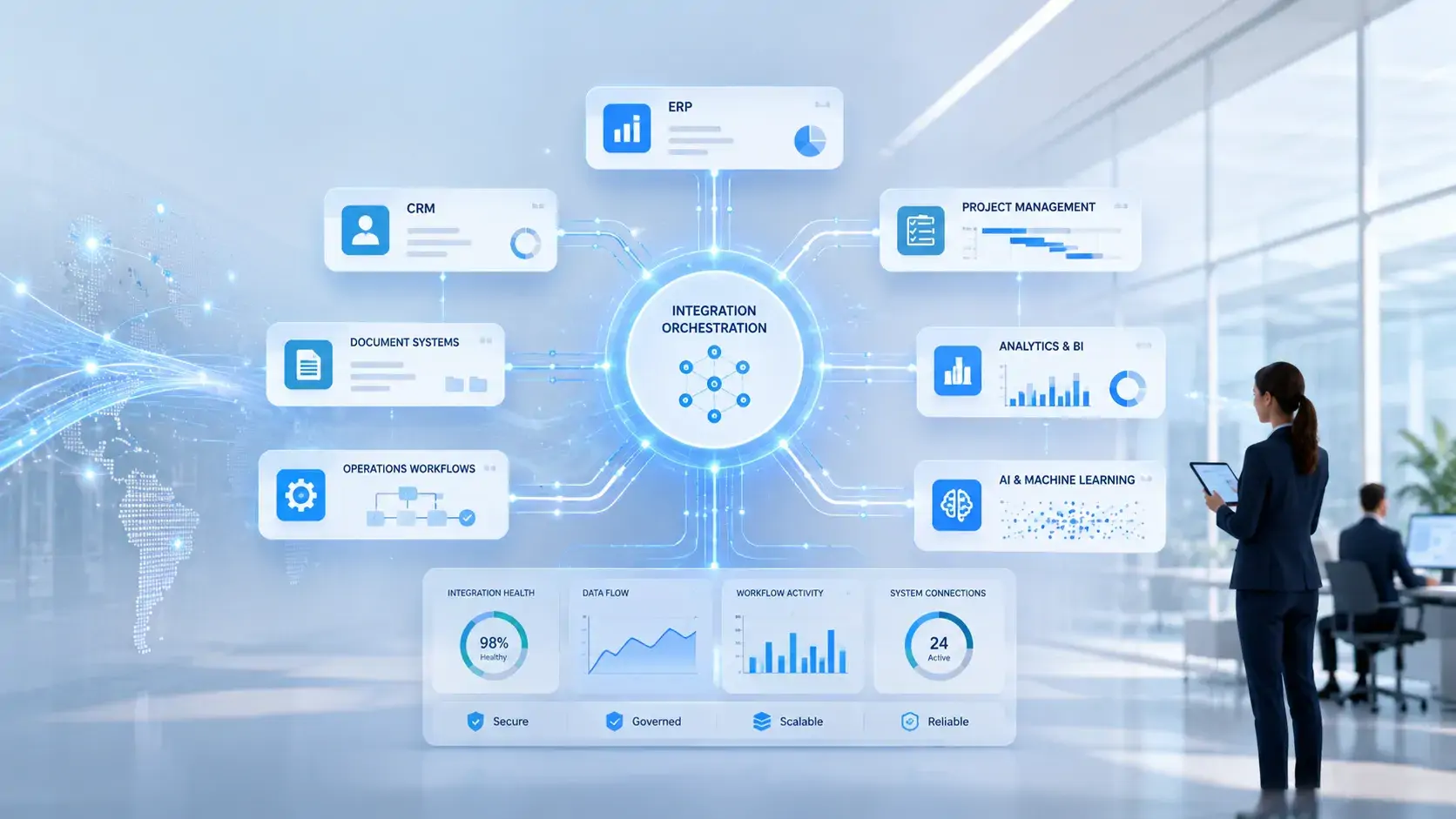
System Integration Solutions for Connected Operations
Discover how system integration solutions connect enterprise data, workflows and AI with existing systems to reduce fragmentation and improve operational visibility....

AI in Physical Security: Smarter Security for Australian Enterprises
Explore how AI in physical security transforms CCTV into intelligent monitoring with real-time threat detection, video analytics and smarter security for Australian enterprises....

Let’s build what’s next for your business
Tell us about your business challenges, we’ll help you shape the right solution.

