
AI Companions for Kids: Bringing Play and Learning Together

Jun 19, 2026



Since 10 December 2025, age-restricted social media platforms have been required to take reasonable steps to prevent Australians under 16 from creating or maintaining accounts.[1] Although the restriction applies specifically to social media, it has renewed attention on the quality and purpose of children’s wider digital experiences.
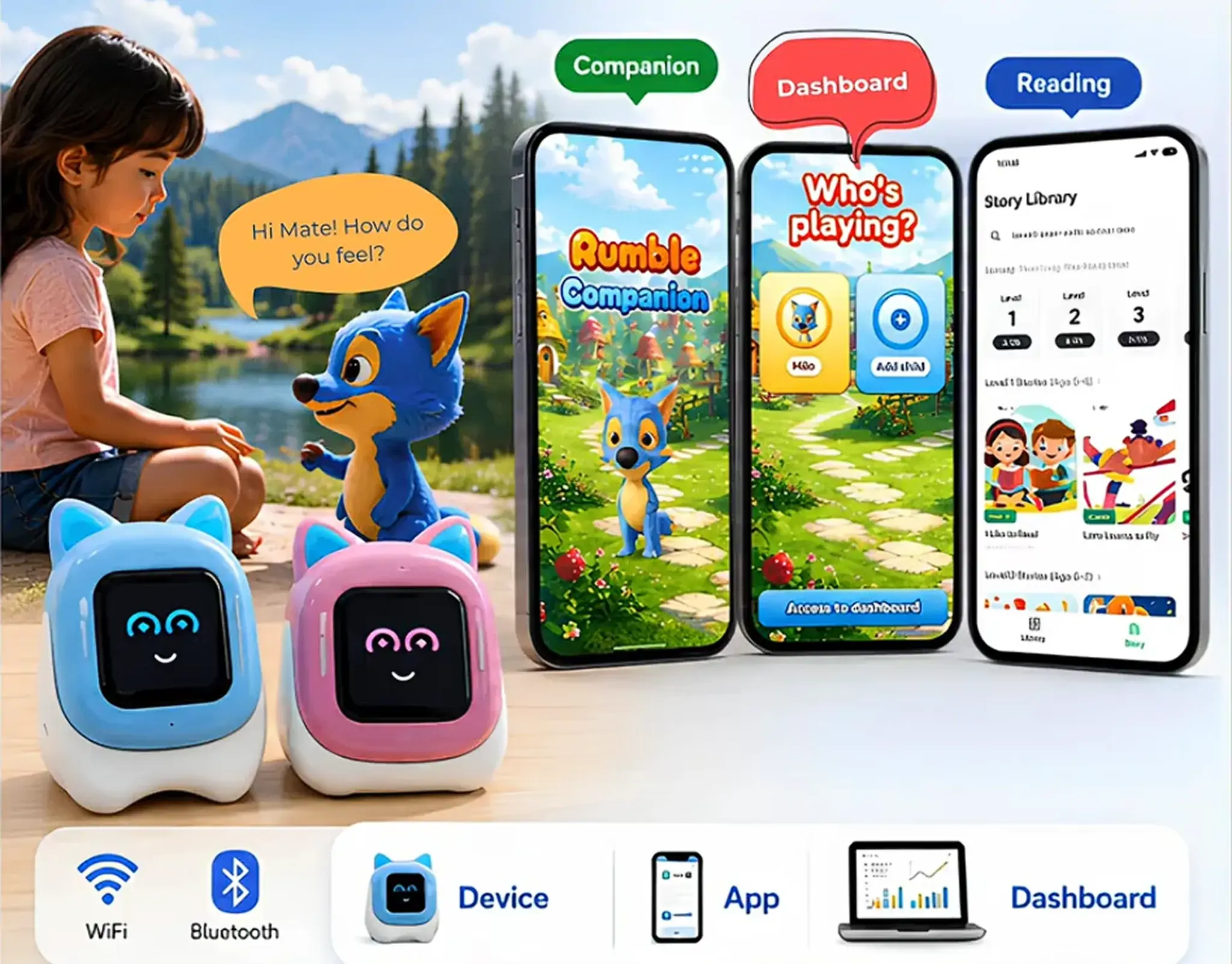
AI Companion for Kid presents a different model for learning through play. Delivered through an application and an interactive robot companion, the solution combines entertainment with opportunities to practise language, numeracy and reasoning. Children participate in interactive stories, questions and minigames, while parents and educators can follow their activity and learning progress.
Digital entertainment and educational applications often serve different purposes. One prioritises engagement, while the other delivers structured lessons and assessments. Moving between them can make learning feel separate from the activities children naturally choose.
AI Companion for Kid brings these experiences into a single conversational interaction. Instead of navigating a conventional application interface, children speak to the companion, respond to questions and participate in guided stories or games.
A typical interaction follows four stages:
The child selects a story, topic or game.
The companion introduces a challenge through conversation.
The child answers, makes a decision or completes an activity.
The next prompt adapts to the response, age and learning level.
This creates a reusable engagement model rather than a fixed sequence of videos or questions. The content can be configured for different learning goals, age groups and service environments.
Access through an application or interactive robot companion
Children can access the experience through a mobile application or a dedicated interactive robot companion. Voice interaction provides a consistent foundation across both formats.
| Access format | Child experience |
| Application | Combines voice conversation with visual content and touch-based activities on a mobile device or tablet |
Interactive robot companion
| Uses spoken responses, animated expressions and simple controls to create a more tangible interaction |
Across both formats, children can ask questions, give answers and make decisions by speaking naturally. Their responses influence what happens next, creating an active exchange rather than a predetermined content sequence.
Voice-led stories and minigames
Interactive storytelling allows children to help shape an activity. They might choose a character’s actions, explain how to solve a problem or create a different ending. The story becomes a participatory experience rather than something they passively watch or hear.
Minigames provide shorter, repeatable activities such as:
riddles and guessing games;
vocabulary and spelling challenges;
memory and sequencing activities;
numeracy questions within an adventure; and
creative speaking and story-building exercises.
The companion can respond with another question, offer an appropriate clue or recommend the next activity. Because each answer can influence the conversation, children do not need to follow an identical sequence every time they play.
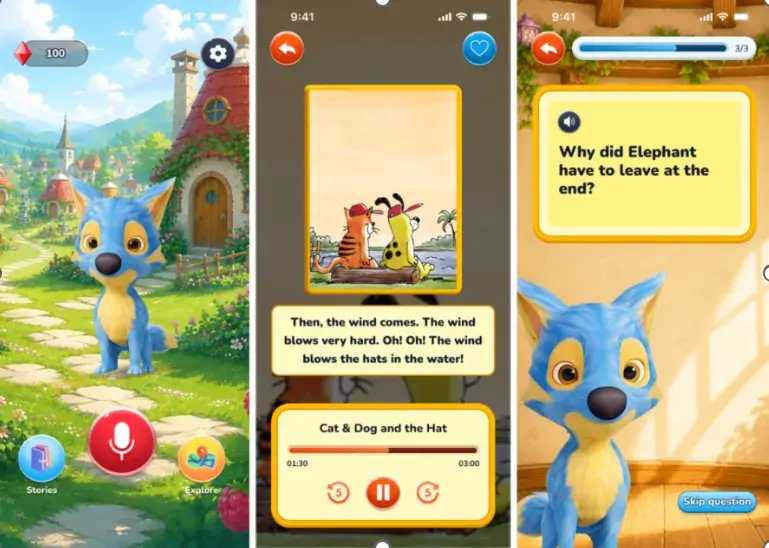
Voice-led activities also provide opportunities to practise listening and spoken language. Children can hear new words, formulate answers and apply vocabulary within a story or game. Selected activities can model pronunciation and encourage children to repeat words in context.
Research indicates that guided storybook conversations with a conversational agent can support comprehension and verbal participation. However, results depend on the design of the activity and the wider learning context.[2]
For education providers, family services and child-support organisations, story and minigame content can be configured for different age groups and learning objectives. The same engagement model can therefore support home activities, classroom learning and professionally guided programs.
Learning does not need to interrupt the experience. Instead, the learning objective becomes part of what the child must do to progress through the activity.
Play experience | Embedded learning opportunity |
Interactive story | Vocabulary, comprehension and decision-making |
Mystery or riddle | Reasoning and problem-solving |
Treasure hunt | Counting, observation and spatial language |
Memory game | Recall, sequencing and concentration |
Story creation | Speaking, imagination and self-expression |
Research into guided approaches to learning through play suggests potential benefits for some learning outcomes, particularly mathematics-related skills. Evidence varies across learning domains, so every activity still requires a defined learning objective and an appropriate method of evaluation.[3]
AI Companion for Kid can operate as a personalized learning system by adapting an activity according to the child’s age, interests and previous interactions. Personalisation may change the difficulty of a question, the type of prompt or the recommended next activity.
Personalisation does not guarantee a learning result. Its purpose is to provide more relevant opportunities for practice while maintaining an appropriate level of challenge.
Visibility for parents and educators
Children experience AI Companion for Kid through conversation and play. Parents, educators and service providers require a different view: how the activities are being used and whether they support the intended learning program.
A dedicated dashboard can provide visibility into:
activity history;
engagement patterns;
learning progress; and
recommended next activities.
Parents can identify the stories and games that attract their child’s interest. Educators can review participation across configured learning activities and connect individual interactions with the wider learning program.
Deployment planning should also consider child-data governance, wellbeing analytics and reporting controls. These requirements will vary according to the organisation, operating environment and intended use of the information.
AI Companion for Kid combines learning through play with stories, games and creative challenges that provide opportunities to practise language, numeracy, memory and reasoning. Voice interaction encourages children to listen, formulate ideas and respond aloud, while a dedicated dashboard gives parents and educators greater visibility into activity and learning progress.
For education providers, family services and children’s technology companies, the opportunity is to configure this interaction model around specific learners, programs and environments rather than introduce another fixed library of digital content. The next step is to define the intended learning objectives, delivery setting and oversight requirements before evaluating the appropriate content, device and technology architecture.
What is AI Companion for Kid?
AI Companion for Kid is a voice-led application and physical device that supports learning through play using conversations, interactive stories, questions and minigames.
How does voice interaction support language development?
Voice activities allow children to listen, answer questions, repeat words, construct sentences and express ideas aloud. Specific learning outcomes depend on the activity design, learning context and the child’s participation.
How does a personalized learning system adapt activities?
It can adjust question difficulty, prompts and recommended activities according to a child’s age, interests and previous interactions. This creates more relevant opportunities for practice but does not guarantee a particular learning result.
Can parents and educators review children’s activities?
Yes. Student engagement analytics can provide visibility into activity history, engagement and learning progress, subject to the configuration and data controls established for the deployment.
How should organisations evaluate a delivery partner?
Assess experience in conversational AI, education technology, child speech recognition, hardware integration and data management. Request working demonstrations and evidence that interactions perform reliably for the intended age group, use case and operating environment.
References
[1] Australian Government eSafety Commissioner, Social media age restrictions, 2026.
[2] Xu, Y. et al., Same Benefits, Different Communication Patterns: Comparing Children’s Reading with a Conversational Agent vs. a Human Partner, Computers & Education, 2021.
[3] Skene, K. et al., Can Guidance During Play Enhance Children’s Learning and Development in Educational Contexts?, Child Development, 2022.


Table of content

Related Insights
Employee Training and Development for Workforce Capability
Explore how enterprises can connect employee training, coaching and skills development to build workforce capability at scale....

System Integration Solutions for Connected Operations
Discover how system integration solutions connect enterprise data, workflows and AI with existing systems to reduce fragmentation and improve operational visibility....

AI in Physical Security: Smarter Security for Australian Enterprises
Explore how AI in physical security transforms CCTV into intelligent monitoring with real-time threat detection, video analytics and smarter security for Australian enterprises....

Let’s build what’s next for your business
Tell us about your business challenges, we’ll help you shape the right solution.

