
Employee Training and Development: Building Workforce Capability at Scale

Jun 19, 2026



Australian education and training providers already use a wide range of digital platforms across learning, administration, finance and learner management. As delivery models and operational requirements become more complex, the challenge is no longer simply adopting more technology, but making existing systems work together.
Australia’s education and training environment also operates at significant scale. In 2024, higher education providers enrolled 1,676,077 students [1], while nationally recognised VET involved approximately 5.1 million students [2]. At this scale, disconnected systems and manual coordination can become operational constraints rather than minor inefficiencies.
Digital education transformation creates greater value when learning, administration, data and workflows operate as a connected environment. For providers, the priority is to reduce manual hand-offs, improve operational visibility and create a technology environment that can scale without unnecessarily replacing systems that still create value.
An organisation can digitise almost every function and still operate inefficiently. Fragmentation occurs when specialist systems solve individual problems, but data and workflows stop at the boundaries between them.
For RTOs, this operational challenge also has a compliance dimension. The 2025 Standards for RTOs, which came into effect on 1 July 2025, strengthen the focus on quality outcomes, integrity and ongoing compliance [3]. When learner, assessment and administrative records are spread across disconnected workflows, maintaining consistent evidence and operational visibility can require additional manual coordination.
Across enrolment, scheduling, attendance, assessment, learner support, certification and reporting, disconnected systems can create duplicate entry, manual hand-offs and additional administration as the organisation grows.
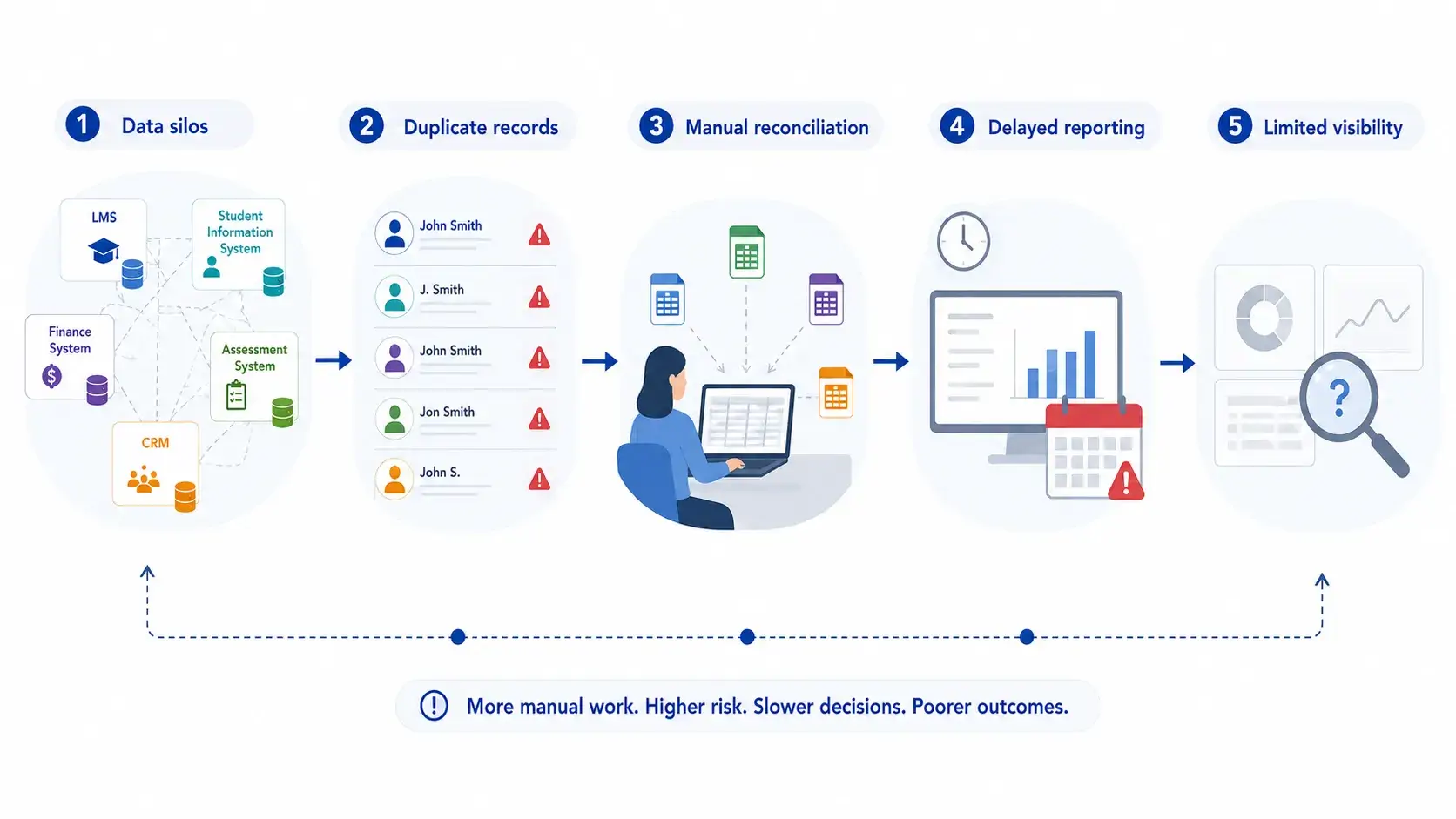
The problem is therefore not the presence of specialist platforms. It is the absence of a connected operating layer that allows systems, data and workflows to work together.
A connected education environment does not require every function to move into one platform. The priority is to connect the systems, information and workflows that need to work together across the learner journey.
Connect the Learner Journey
A connected learner journey can be represented as:
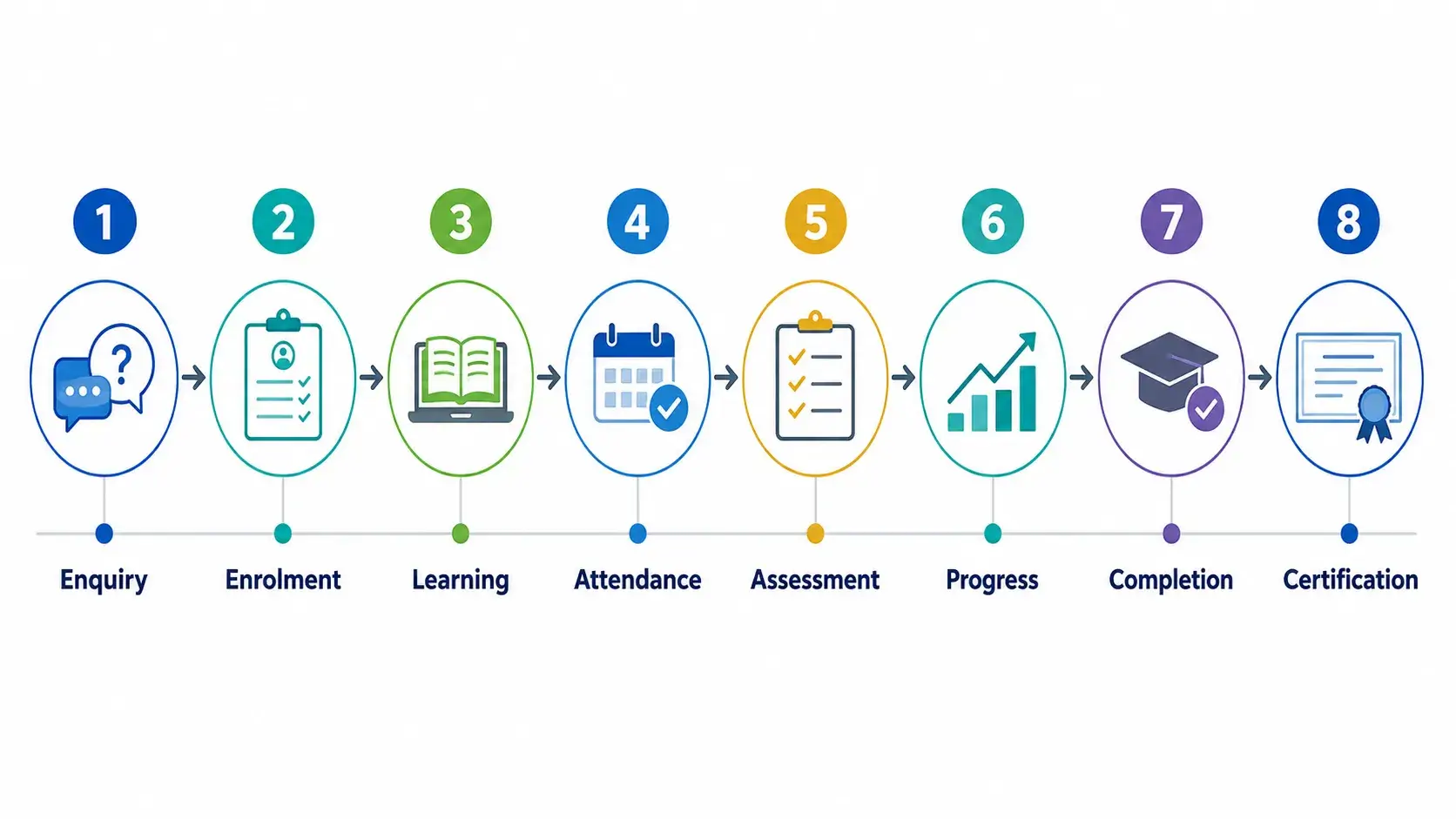
Connecting these stages helps keep learner information consistent across processes and allows validated data to be reused rather than repeatedly entered. Admissions, teaching, finance and management teams can work from more consistent information, improving coordination across the learner journey.
Automate Manual Workflows
Workflow automation can reduce repetitive hand-offs between enrolment, scheduling, attendance, assessment and follow-up activities. Validated information can move to the next operational step without relying on spreadsheets, email or repeated manual entry.
The goal is not to automate every task. It is to reduce routine administration while allowing staff to focus on exceptions and learner needs that require human judgement.
Improve Data Visibility
Connected data also changes the role of analytics.
Reporting: What happened?
Analytics: What patterns are emerging?
Operational intelligence: What action should follow?
Connected data gives teams greater visibility across learner and operational activity. Falling attendance combined with declining assessment performance, for example, creates more value when it can trigger an appropriate follow-up workflow rather than simply appearing on a dashboard.
Work With Existing Systems
Education providers rarely start with a blank technology environment. Modern education technology therefore needs to work with valuable existing LMS, CRM, finance and administration systems rather than assume that every platform should be replaced.
Integration and configurable workflows allow the environment to evolve while preserving systems that continue to support the organisation effectively.
KPS Training Management System provides a practical example of this connected approach by supporting learner management, academic workflows and operational information within a coordinated environment while working alongside existing systems [4].
In a KPS multi-campus Kd enrolment man–12 implementation, admissions, academic operations and finance had been managed across separate systems and manual processes. KPS connected enquiry anagement, scheduling, attendance, assessments, finance activities and operational reporting, helping reduce duplicated work and improve visibility across campus operations [5].
The case demonstrates the role of a Training Management System in digital education transformation: not simply adding another application, but creating a more connected operational layer around learning, administration and existing technology [4][5].
Creating that connected layer is only part of the challenge. The solution also needs to fit the organisation's existing technology environment and remain adaptable as operational requirements change. This makes integration, configurability and progressive expansion important considerations for long-term value.
Education technology solutions deliver more durable value when they fit the operating model of the organisation. This is particularly important in education, where providers may already have years of investment in learning, finance, CRM and administration systems.
Integrate With Existing Systems
Digital transformation does not automatically justify rip-and-replace. Providers should first determine which platforms should remain systems of record, who owns key learner data, how identities are resolved and where APIs or controlled data exchanges are required.
The objective is to retain technology that continues to create value, integrate where data or workflows need to cross system boundaries and replace platforms only where they genuinely limit the target operating model.
Configure for Different Operations
RTOs, higher education institutions, professional development organisations, workforce training providers and multi-campus operators do not follow identical processes.
Education technology solutions therefore need configurable enrolment, assessment and operational workflows that can accommodate new programmes, campuses, trainers and integrations as requirements change.
Technology should be fitted to operations rather than operations fitted to software.
Expand in Stages
Transformation does not need to happen through one large migration. Providers can begin with a high-value workflow, identify the relevant systems and data dependencies, validate the approach and then extend it further.
For example, an organisation might first connect enrolment-to-attendance or attendance-to-compliance evidence before expanding the approach across additional learner and administrative processes.
Data governance, privacy, security and access controls should be considered as part of each stage rather than addressed after implementation.
Digital education transformation creates greater value when technology improves how learning, administration, data and operational workflows work together. For providers, the priority is not simply adding more digital tools, but choosing solutions that can connect existing environments, reduce manual processes and support future change.
KPS works with education and training providers to integrate, configure and evolve technology around existing systems and operational requirements. Its Training Management System provides one example of how connected learner and administrative workflows can support a more scalable education operating environment [4][6].
Does education transformation require replacing existing systems?
No. Existing LMS, CRM, HR and finance platforms can often remain in place and be connected through APIs and shared data models. Replacement may justify when a legacy platform creates limitations that integration or configuration cannot reasonably resolve.
Is an LMS enough for digital transformation in education?
An LMS is a core learning-delivery platform, but transformation extends into learner administration, compliance, finance, data and operational workflows. The objective is to connect these functions, not diminish the role of the LMS.
Which capabilities matter in a digital education solution?
Key capabilities include connected learner management, workflow automation, integration with existing systems, operational visibility, configurable workflows and the ability to scale as delivery models or organisational requirements change.
What matters when selecting an education technology partner?
When evaluating education technology solutions, prioritise integration capability, configurability, data governance and scalability. The partner should understand existing operations and adapt the solution accordingly. KPS's Training Management System demonstrates this fit-to-operation approach [4].
References
[1] Australian Government Department of Education — Key findings from the 2024 Higher Education Student Statistics.
[2] National Centre for Vocational Education Research — Total VET students and courses 2024.
[3] Australian Government Department of Employment and Workplace Relations — 2025 Standards for Registered Training Organisations.
[4] KPS Solutions — Training Management System.
[5] KPS Solutions — K-12 Education Management Case Study: Streamlining Operations with T-EduOne.
[6] KPS Solutions — Education Technology Solutions.


Table of content

Related Insights
Employee Training and Development for Workforce Capability
Explore how enterprises can connect employee training, coaching and skills development to build workforce capability at scale....
System Integration Solutions for Connected Operations
Discover how system integration solutions connect enterprise data, workflows and AI with existing systems to reduce fragmentation and improve operational visibility....

AI in Physical Security: Smarter Security for Australian Enterprises
Explore how AI in physical security transforms CCTV into intelligent monitoring with real-time threat detection, video analytics and smarter security for Australian enterprises....

Let’s build what’s next for your business
Tell us about your business challenges, we’ll help you shape the right solution.

