
Security ROI Is Changing: How Advanced Security Technology Proves Business Value

Jun 19, 2026



Security investment has traditionally been justified by risk reduction, loss prevention and protection of people, assets and operations. But enterprise decision-makers increasingly need to ask: what measurable business value does the investment create?
Only 53% of security professionals surveyed by ASIS said their organisations measure security ROI. Of these, 34% use quantifiable measures while 62% rely on qualitative descriptions [1]. The industry is also placing greater emphasis on “Return on Security” and end-user risk and operational outcomes, rather than treating security as a cost alone [2]. For organisations evaluating advanced security technology, the business case must connect technology capability with measurable outcomes, lifecycle cost and business value.
Security still has a fundamental role in reducing exposure to incidents, losses and disruption. Its contribution, however, increasingly extends into operational performance and business resilience. 61% of security professionals surveyed by ASIS viewed security as primarily or mostly a business enabler, compared with 10% who viewed it primarily or mostly as a cost centre [1]. That shift makes the ability to explain business impact more important when organisations assess enterprise security solutions.
The measurement gap remains significant. If most organisations measuring ROI still rely on qualitative descriptions, the challenge is not proving that security matters; it is showing what changes because a particular investment was made.
A useful business case starts with the problem that needs to change, not the features a technology happens to offer.
Start With the Business Problem
Define the issue in operational terms: risk exposure, recurring incidents, slow investigation or response, disruption, inefficient processes or underused resources. This establishes what advanced security technology is expected to improve. It also prevents a business case from becoming a feature checklist where sophisticated capabilities are treated as value in themselves.
Establish the Baseline
A baseline shows the current position before investment. Depending on the use case, this may include incident frequency, response or investigation time, operating cost, downtime, staff hours and resource utilisation. Without a baseline, an organisation can show that a system is functioning but may struggle to demonstrate meaningful improvement.
Identify the Technology Capability
Only after the problem and baseline are clear should the required capability be defined. This may include centralised visibility, system integration, automated detection, workflow automation or analytics. For organisations adopting security automation solutions, the capability should address the operational problem rather than automation itself.
The capability must fit the environment. Technology does not create an outcome automatically; implementation quality, infrastructure, integration, data and operating practices all influence results.
Define the Measurable Outcome
- Security ROI can be assessed across several dimensions:
- Risk and loss reduction: incidents, severity, losses, recoveries and detection or response performance.
- Operational efficiency: investigation time, process time, staff hours and resource utilisation.
- Business continuity: disruption, downtime and recovery capability.
- Workforce effectiveness: capacity and workload distribution.
Security ROI can include avoided losses, recoveries and cost effectiveness, while benefits such as risk mitigation can remain difficult to monetise fully [3]. The measurement logic is:
Business Problem → Baseline → Technology Capability → Measurable Outcome
→ Lifecycle Cost → Business Value
For example, faster information retrieval may shorten an investigation, while integrated systems may reduce duplicated activity. Security automation solutions should therefore be judged by the operational outcome they enable, not by the amount of automation deployed.
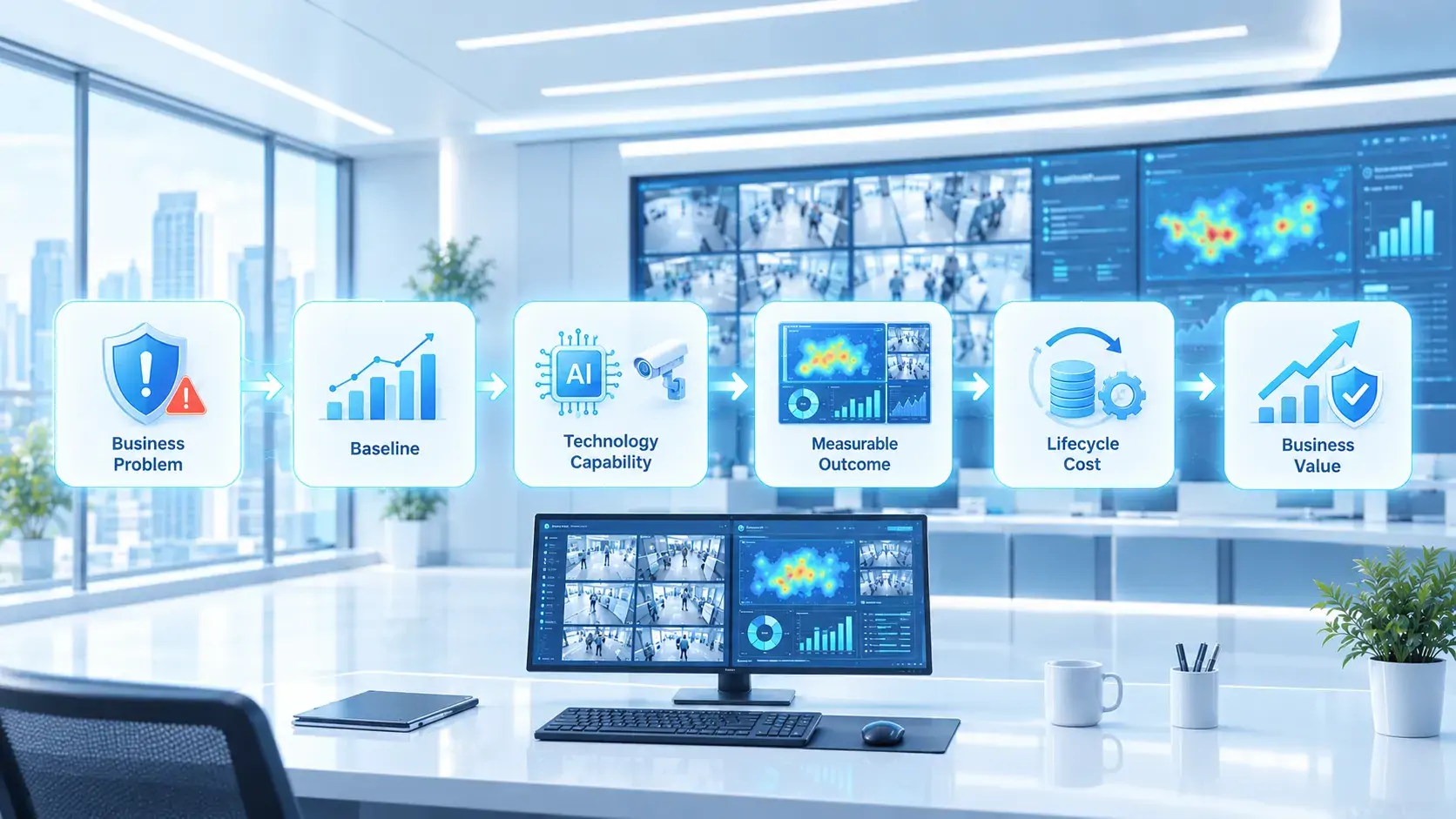
A measurable outcome is only one side of the investment case. The organisation also needs to understand the full cost of creating and maintaining the capability.
Look Beyond the Purchase Price
The cost of advanced security technology can include implementation, integration, infrastructure, training, maintenance and ongoing operation, with storage, network capacity and compute adding further costs depending on the architecture. This is particularly relevant to AI-enabled security. A 2026 SIA-hosted article highlights data transfer, storage, network egress, power, cooling and infrastructure as factors affecting the economics of physical-AI deployments, noting that pilot economics may not translate directly to enterprise scale [4].
For digital security solutions, the business case should therefore account for the operating environment, not just the software or hardware purchase.
Include the Value of Existing Infrastructure
Modernisation does not automatically mean replacement. Assess compatibility, integration and scalability before discarding existing investments. More than 70% of respondents in Genetec’s 2026 global survey reported using unified or integrated physical security systems, while 60% said integrating new capabilities was the main motivation for replacing legacy technology [5].
Existing infrastructure can therefore be part of the value equation. A solution that extends useful capabilities from current assets may deliver more value while avoiding unnecessary replacement.
Financial Value Is Only One Part of the Picture
Financial measures can include avoided losses, recoveries, operating costs, lifecycle costs and cost effectiveness [3]. But forcing every security benefit into a dollar figure can create false precision.
Risk reduction, resilience and operational KPIs can support an investment case when linked to defined business objectives. For enterprise security solutions, these measures help assess value beyond the initial purchase. Australian guidance increasingly treats security-related risk as an enterprise concern spanning people, assets, information and reputation [6].
The framework becomes useful when applied consistently across the investment lifecycle.
Use the Measurement Framework Across the Investment Lifecycle
Define the business problem - What needs to improve?
Document the baseline - What is happening today?
Identify the required capability - What must the technology enable?
Define measurable outcomes - What evidence will demonstrate improvement?
Calculate lifecycle cost - What will the investment cost over time?
Assess business value - Does the measurable outcome justify the investment?
Value dimension | What to measure | Business question |
| Risk reduction | Incidents, severity, losses, recoveries | Is security exposure changing? |
| Operational efficiency | Process/investigation time, workload | Are processes becoming more efficient? |
| Workforce effectiveness | Staff hours, resource utilisation | Are resources being used more effectively? |
| Business continuity | Downtime, disruption, recovery | Can critical operations recover more effectively? |
| Infrastructure value | Existing assets, capabilities added | Is existing investment being used more effectively? |
| Financial value | Avoided, operating and lifecycle costs | Does the outcome justify the investment? |
Treat ROI as an Ongoing Evaluation
ROI should not be calculated only to secure the initial budget. After deployment, compare actual performance with the original baseline, ongoing operating cost and intended outcomes. For security automation solutions, this helps distinguish genuine improvement from technology that simply adds another layer of systems and cost.
Security value is increasingly a cross-business question. Gallagher’s 2026 industry report identifies ROI as a shared language among security leaders, executives, IT and operations, while integration is reported as the number-one factor influencing security system decisions [7]. That broader involvement changes how enterprise security solutions should be evaluated. Security, IT, facilities, finance and executive stakeholders may each view value differently, so the business case needs common measures that connect security performance with organisational priorities.
The same principle applies to advanced security technology: the most sophisticated solution is not automatically the most valuable. Fit, integration, scalability, implementation quality and measurable outcomes determine whether technology creates sustainable value.
Security technology should protect people, assets and operations while delivering measurable outcomes at a sustainable lifecycle cost. This is particularly important for digital security solutions, where integration and ongoing operating costs can affect long-term value.
KPS combines Advisory & Strategy, Solution Customisation and Technology Integration to design security technology around existing infrastructure and operational requirements. Its Video Management System provides centralised visibility, intelligent video analytics and proactive alerts, while Agentic Vision supports AI-powered detection, contextual decision-making and automated response workflows.
These capabilities should be evaluated against the organisation’s own baseline and objectives rather than treated as guaranteed ROI. The value of advanced security technology depends on the problem being addressed, the deployment environment and the outcomes that can be measured. For organisations considering digital security solutions, the stronger question is not simply what a system can do, but whether it addresses a defined problem, produces measurable improvement and remains valuable over its lifecycle.
Explore KPS Safety & Security to assess tailored security technology and integration capabilities.
What Is Security ROI?
Security ROI evaluates the value generated by a security investment relative to its cost. It can include avoided losses, recoveries, operational improvements, risk reduction and other measurable outcomes.
How Do You Measure the ROI of Security Technology?
Define the business problem and baseline, identify the required capability, set measurable outcomes, calculate lifecycle cost and assess the resulting business value.
What Should Be Included in Security Technology Investment Costs?
Include implementation, integration, infrastructure, training, maintenance, upgrades and ongoing operating costs. Storage, network and compute may also be relevant.
Can Security Technology Improve Operational Efficiency?
Yes, depending on the use case. Measure investigation time, process time, staff hours and resource utilisation to determine whether efficiency has actually improved.
How Should Businesses Evaluate Advanced Security Technology?
Assess the business problem, baseline, capabilities, integration, lifecycle cost, scalability, implementation expertise and the provider’s ability to support long-term requirements.
References
[1] ASIS International - ASIS Research Aims to Measure Security’s Evolving Business Role
[2] Security Industry Association - 2026 Security Megatrends
[3] ASIS International - How to Measure Your Security and Resilience ROI
[4] Security Industry Association - AI in Security: Infrastructure, Not Hype, Will Determine ROI
[5] Genetec - 2026 Global State of Physical Security Report [6] Standards Australia — SA HB 167:2025, Managing Security-Related Risks
[7] Gallagher Security - 2026 Security Industry Trends Report


Table of content

Related Insights
Employee Training and Development for Workforce Capability
Explore how enterprises can connect employee training, coaching and skills development to build workforce capability at scale....
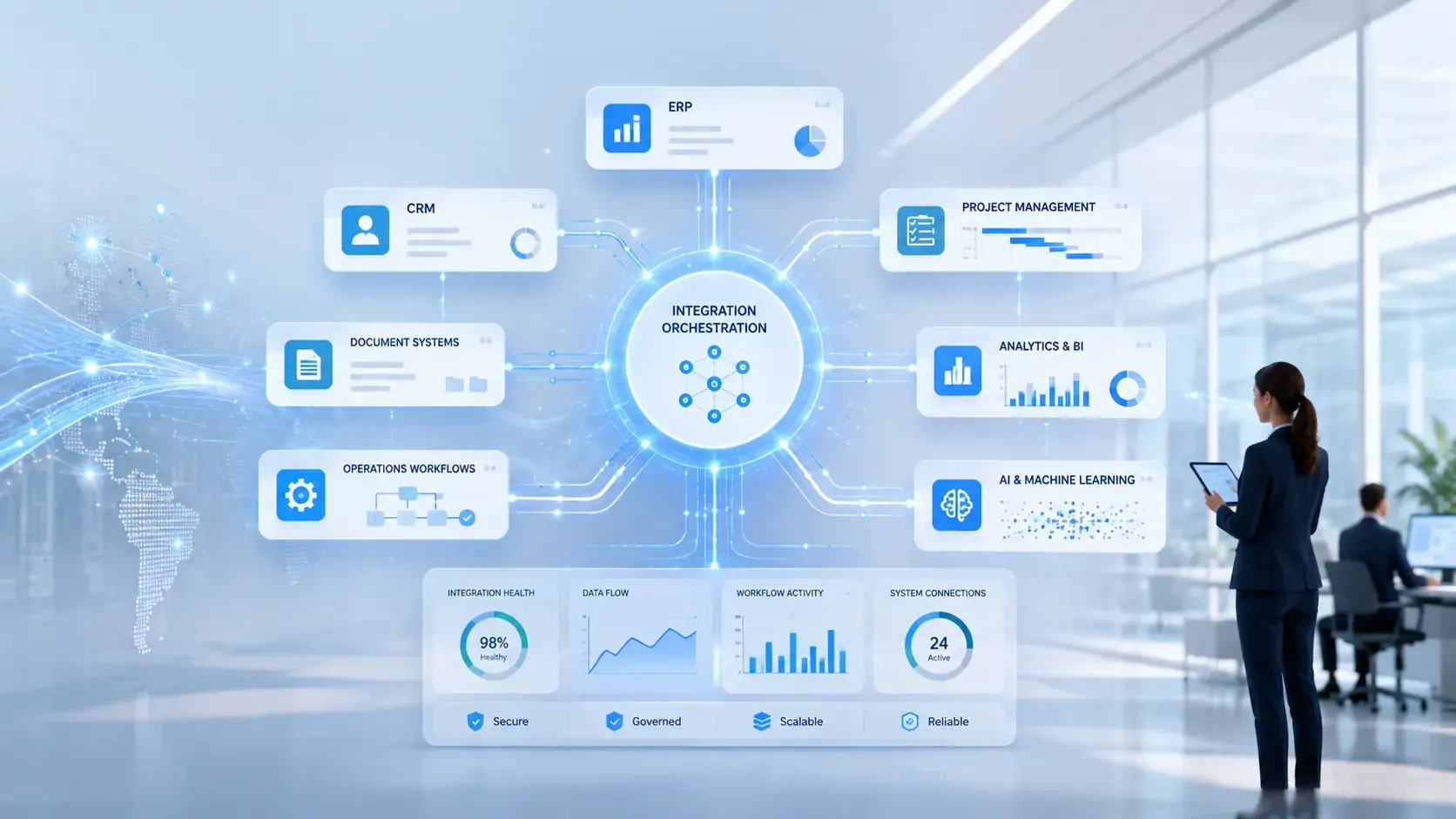
System Integration Solutions for Connected Operations
Discover how system integration solutions connect enterprise data, workflows and AI with existing systems to reduce fragmentation and improve operational visibility....

AI in Physical Security: Smarter Security for Australian Enterprises
Explore how AI in physical security transforms CCTV into intelligent monitoring with real-time threat detection, video analytics and smarter security for Australian enterprises....

Let’s build what’s next for your business
Tell us about your business challenges, we’ll help you shape the right solution.

