
LLM Security Gateway for Secure and Governed Enterprise AI

Jun 19, 2026



Enterprise AI is moving from isolated experimentation into everyday business operations. Employees are using AI assistants, applications are connecting to LLMs through APIs, and organisations are adopting different models for different workloads.
This shift is already visible in Australia. The Australian Government's 2025 AI Adoption Tracker reported that 41% of Australian small and medium-sized businesses were adopting AI, with 22% reporting faster decision-making and 18% reporting improved productivity. [1]
As adoption grows, however, the governance challenge grows with it. Netskope's 2026 research found that 94% of surveyed organisations lack complete visibility into AI activity, while only 7% reported having real-time security governance in place. [2]
This creates a practical enterprise problem. Security teams need to understand where AI is being used, what information is being exchanged and whether the right policies are being applied, without creating barriers that encourage employees or application teams to bypass approved systems.
An LLM Security Gateway addresses this broader challenge by introducing a central control layer between enterprise users and applications and the LLMs they access.
As enterprise AI expands, organisations face two core challenges: protecting sensitive data and maintaining consistent control across AI usage.
Protecting Enterprise Data
AI interactions can involve customer information, internal documents, source code and other sensitive business data. Without appropriate controls, this can increase the risk of data exposure, privacy issues and compliance breaches.
Maintaining Consistent Control
AI may be used across different teams, applications and LLM providers. When each connection is managed separately, organisations can end up with duplicated controls, inconsistent policies and fragmented monitoring.
This creates practical business impacts: higher operational effort, greater compliance risk, limited visibility and slower AI scaling. Netskope's 2026 research found that 50% of organisations lack enforceable data-protection policies for generative AI applications, while observed AI data-policy violations doubled year over year. [2]
The challenge is therefore not only to enable AI, but to scale it without increasing security risk, governance complexity and operational overhead.
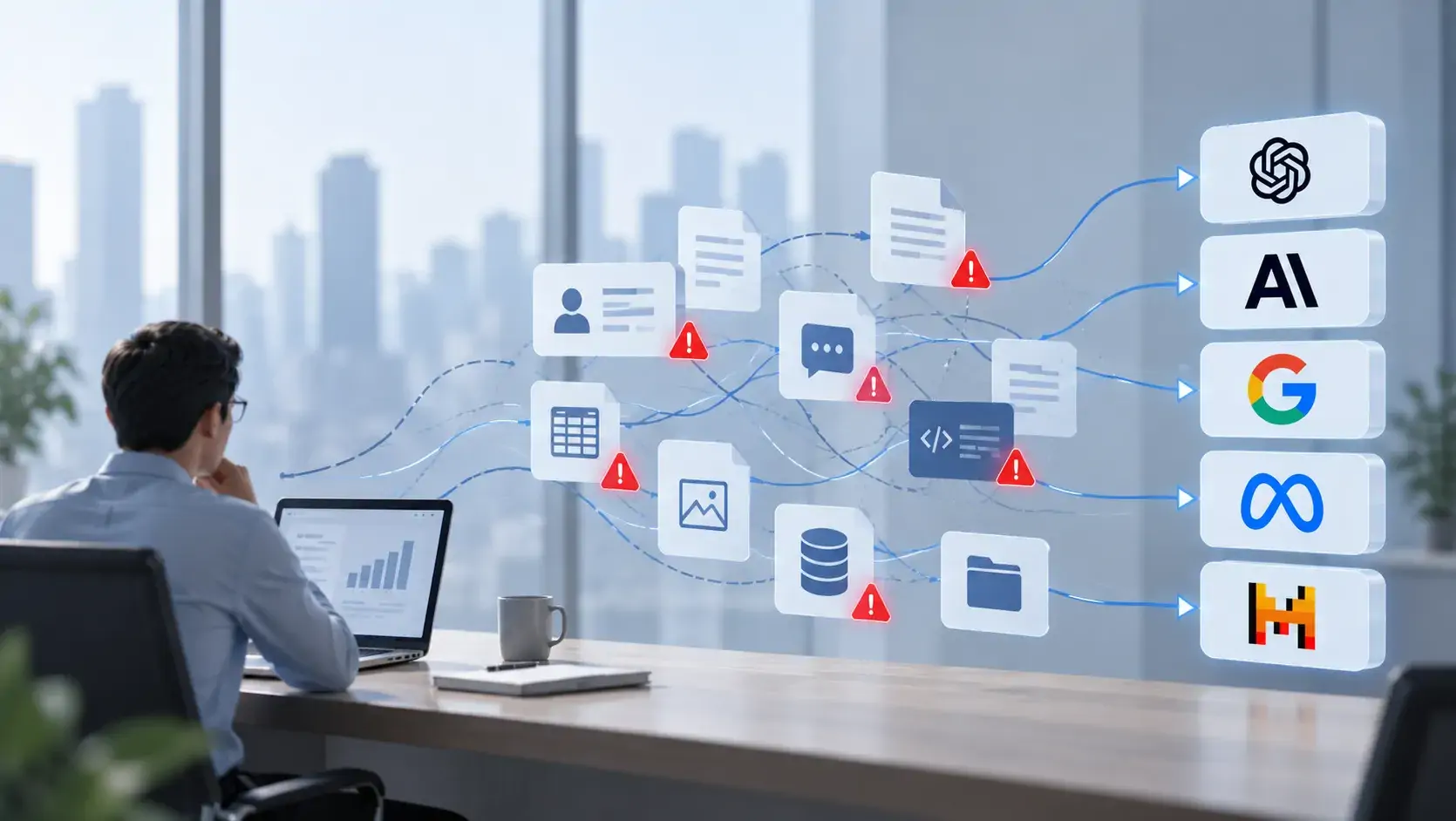
Once employees and applications access multiple AI models, securing each connection separately becomes difficult to manage. Every application may need its own access rules, security checks and monitoring, creating duplicated controls and inconsistent enforcement.
An LLM Security Gateway provides a single control point between the organisation and the LLMs it uses:
Employees / Applications → LLM Security Gateway → Approved LLMs
Instead of each user or application connecting directly to different models, AI requests pass through the gateway first. The gateway can then check who is making the request, which model they are accessing, what data is being sent and whether the interaction complies with enterprise policies.
The key advantage is that enterprises do not need to standardise on a single LLM. Different teams can continue using models that suit their workloads, while the organisation applies common security and governance controls through one central layer.
The purpose of enterprise AI security is not simply to restrict access. If approved AI becomes difficult to use, employees and application teams may seek alternative tools outside the organisation's control.
The stronger approach is to create a governed path that makes approved AI accessible while applying controls where the interaction occurs.
This creates three practical control points:
Control | Purpose |
Access | Determine who can use which models and capabilities |
Interaction | Inspect AI inputs and outputs for security risks |
Governance | Apply policies, monitor activity and maintain audit records |
The result is a security model built around the AI interaction, rather than relying only on application-level controls.
KPS LLM Security Gateway & Chat Hub brings the control model together across LLM access, AI security, governance and employee access.
Capability | Business Value |
Centralised LLM Gateway | Simplifies multi-LLM management |
AI Security & Data Protection | Protects sensitive information and AI interactions |
Policy-Based Governance | Applies consistent AI controls |
Monitoring & Audit | Improves visibility and accountability |
Unified AI Chat Hub | Provides controlled AI access for employees |
Cloud & On-Premises Deployment | Fits enterprise infrastructure requirements |
The value of an AI control layer depends on how well it fits the organisation's existing technology and governance environment. KPS takes an integration-led approach, working with existing infrastructure and business requirements to shape an AI architecture that can evolve with changing models, workloads and security needs.
This approach extends beyond LLM governance into the broader enterprise technology environment, where AI needs to connect with existing systems, data and workflows.
Explore how KPS approaches enterprise technology solutions to build and integrate fit-for-purpose architectures.
Enterprise AI can only scale sustainably when security and governance scale with it. Rather than managing each model, application or use case separately, organisations need consistent controls built into how AI is accessed and used. An LLM Security Gateway provides this foundation, helping enterprises protect sensitive data, enforce policies and maintain control across AI interactions while retaining the flexibility to adopt different models as business needs evolve.
As AI becomes more embedded across the organisation, the priority shifts from simply adopting AI to governing it securely at scale.
Explore KPS LLM Security Gateway & Chat Hub or talk to our team about your enterprise AI security requirements.
Explore KPS LLM Security Gateway & Chat Hub or talk to our team about your enterprise AI security requirements.
1. What is an LLM Security Gateway?
An LLM Security Gateway is a central control layer between enterprise users or applications and LLM providers. It can manage model access, inspect AI interactions, enforce policies and provide monitoring and audit visibility.
2. Why do enterprises need an LLM Security Gateway?
Multiple models and AI applications can create fragmented access and inconsistent security controls. A gateway centralises common controls while allowing different applications and teams to use approved models for their specific requirements.
3. Can an LLM Security Gateway protect sensitive enterprise data?
Yes. Depending on its implementation, a gateway can inspect prompts, responses and related AI interactions for sensitive information and enforce data-protection policies before information reaches an LLM.
4. Can an LLM Security Gateway support multiple LLM providers?
Yes. A gateway can provide a common access layer for commercial, internal and open-source models, allowing enterprises to manage model access centrally while retaining flexibility in model selection.
5. How should an enterprise evaluate an LLM Security Gateway vendor?
Evaluate security inspection, policy controls, auditability, model support, deployment options, extensibility and integration with existing infrastructure. Ask vendors to demonstrate controls against real enterprise use cases rather than relying on feature lists.
References
[1] Netskope, Netskope AI Report 2026 — AI adoption, visibility and security governance.
[2] Netskope, Netskope AI Report 2026 — Generative AI data-policy violations and enterprise AI risks.
[3] Palo Alto Networks, What Is an AI Gateway? — AI Gateway architecture and centralised AI control.
[4] European Commission, Principles of the GDPR — Data minimisation, purpose limitation, integrity, confidentiality and accountability.
[5] ISO, ISO/IEC 27001:2022 — Information Security Management Systems — Requirements for information security management systems.


Table of content

Related Insights
Employee Training and Development for Workforce Capability
Explore how enterprises can connect employee training, coaching and skills development to build workforce capability at scale....
System Integration Solutions for Connected Operations
Discover how system integration solutions connect enterprise data, workflows and AI with existing systems to reduce fragmentation and improve operational visibility....

AI in Physical Security: Smarter Security for Australian Enterprises
Explore how AI in physical security transforms CCTV into intelligent monitoring with real-time threat detection, video analytics and smarter security for Australian enterprises....

Let’s build what’s next for your business
Tell us about your business challenges, we’ll help you shape the right solution.

