
Digital Transformation Solutions: From Digitisation to Transformation

Jun 19, 2026



Many organisations describe themselves as being in the middle of digital transformation. Yet in practice, they may have simply digitised processes without fundamentally changing how the business operates.
The gap is particularly relevant in Australia. According to the Australian Bureau of Statistics (ABS), just over one in ten Australian businesses (12%) reported using artificial intelligence (AI) in 2024–25, up from 1% in 2022–23. AI adoption was considerably higher among larger businesses, with 37% of large, innovation-active businesses reporting AI use.[1] Accenture, meanwhile, found that 40% of the 50 Australian organisations it surveyed fell within the global bottom quartile for digital maturity when compared with global peers.[2]
The distinction matters: Digitisation, digitalisation and digital transformation represent different stages of maturity. Treating them as interchangeable can lead businesses to invest in the wrong areas and measure progress against the wrong benchmarks.
For organisations looking to progress beyond isolated technology investments, digital transformation solutions can help connect technology adoption with broader changes in processes, capabilities and operating models. Digital transformation services can support this journey by turning these capabilities into practical improvements across the business. This article explores these three stages and examines where Australian businesses currently sit, using AI adoption as a practical indicator.
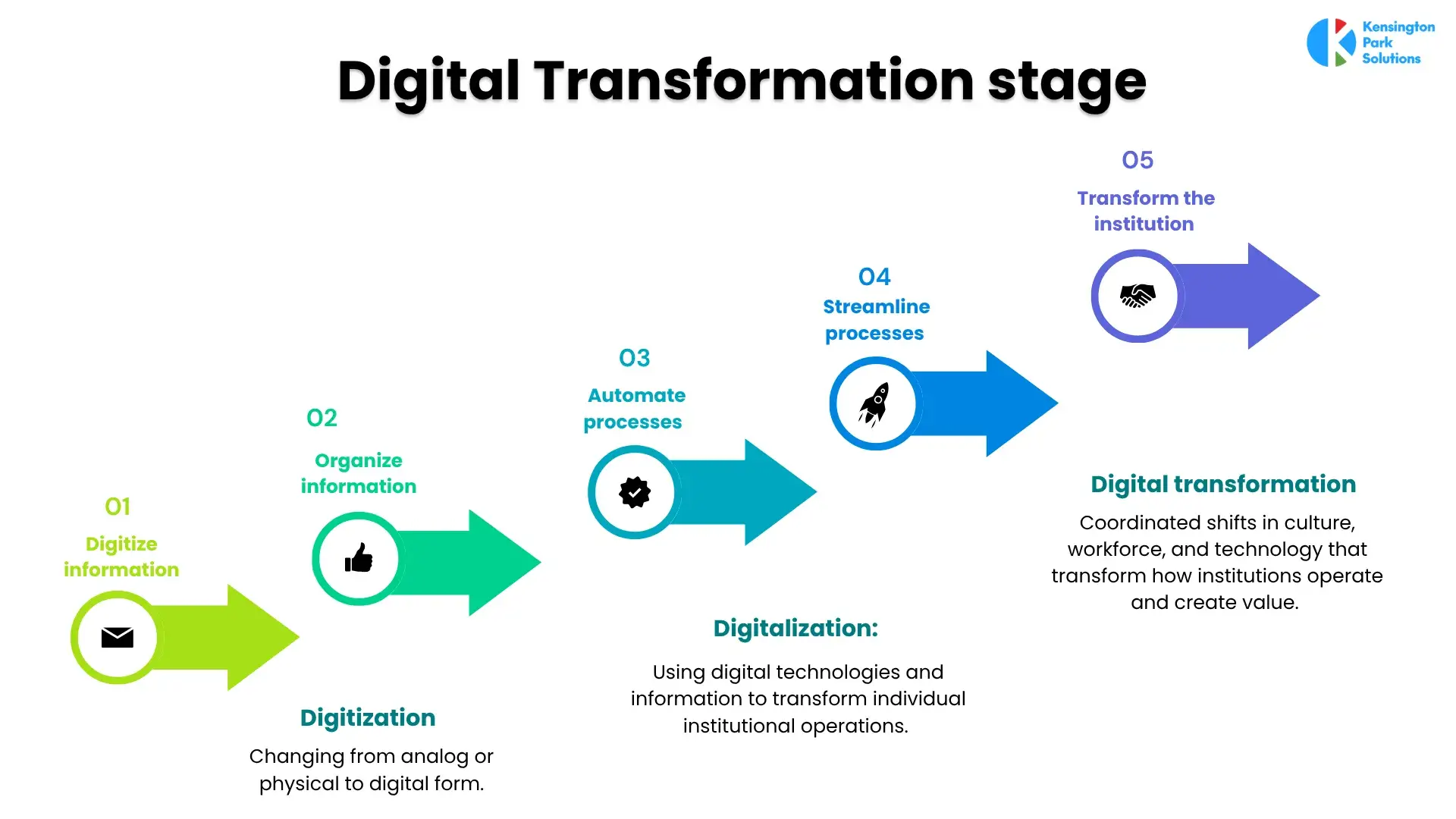
These terms are often used interchangeably, but they represent a progression. Across the three stages, the journey can be viewed as five practical steps, each building on the previous one.
Digitisation: Converting Information into Digital Form
Step 1, Digitise information. Paper documents, handwritten records and other physical information are converted into digital formats.
Step 2, Organise information. Digital information is classified and structured so it can be stored, retrieved and used efficiently.
At this stage, the information itself has not changed. Only its format and accessibility have. Digitisation creates the foundation for what follows but does not fundamentally change how the organisation operates.
Digitalisation: Improving Operational Processes
Step 3, Automate processes. Repetitive tasks are automated through workflows, bots and other digital tools, reducing manual effort and errors.
Step 4, Streamline processes. End-to-end workflows are reviewed and optimised to remove bottlenecks and improve how different functions work together.
This is where organisations typically see measurable gains in speed, accuracy and cost efficiency.
Digital Transformation: Reshaping the Organisation
Step 5, Transform the organisation. The business develops new capabilities, operating models or value propositions that did not exist before.
This is a structural change, not simply a technology upgrade. It can involve leadership, culture, workforce capabilities and, in some cases, the revenue model itself.
At this stage, technology becomes an enabler of broader organisational change. KPS digital transformation solutions can help enterprises implement new ways of working, support evolving operating models and enable the organisation to create and deliver value differently.
Ultimately, the distinction is not about the technology an organisation adopts. It is about what changes as a result: the information, the way work is done, or the organisation itself.
A useful way to put these definitions into perspective is to look at how Australian businesses are using AI today. A clear pattern is emerging: AI adoption is largely focused on enhancing existing processes rather than fundamentally reshaping how businesses operate.
The pace of adoption, however, is accelerating, although unevenly across the market. The ABS reports that 12% of Australian businesses used AI in 2024–25, while more recent data from the National AI Centre shows that 43% of Australian SMEs reported some level of AI adoption between December 2025 and February 2026.[1][3] Together, these figures point to a market that is moving beyond basic digitisation, but where the depth and maturity of AI adoption still vary significantly.
For many organisations, this means AI is currently enabling AI-enhanced digitalisation: automating tasks, accelerating workflows and improving existing ways of working. The next step is to move beyond incremental improvements and use AI to rethink processes, operating models and how value is delivered.
As this transition gathers pace, businesses will increasingly need to connect AI adoption with broader changes across their technology, data and operations. This is where the right technology solutions partner can play an important role, helping organisations move from isolated AI use cases towards a more integrated and scalable approach to digital transformation.
Which Sector Is Leading This Shift
Foundation models are beginning to reshape industries, with professional services at the forefront. This is unsurprising given the sector's high concentration of knowledge-based work, which aligns closely with current AI capabilities.
Adoption, however, remains uneven. Health, education, manufacturing and other services are among the sectors better positioned to apply AI, supported by data availability, knowledge-intensive work and process standardisation. Retail, hospitality, distribution, construction and agriculture face greater barriers, including hands-on operations, fragmented technology infrastructure and tighter margins for experimentation
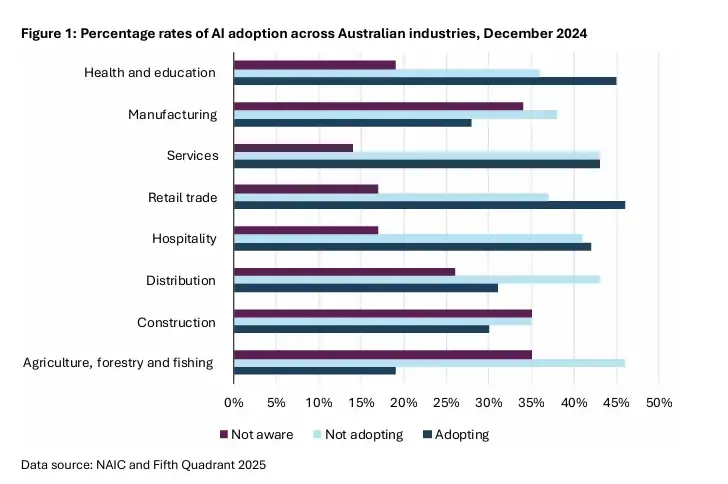
This divergence reinforces the point that adoption is not simply a matter of intent. It reflects how well suited a sector's underlying work is to current AI capability, and how much infrastructure and capital a business has available to build on top of that capability. Digital transformation solutions therefore need to reflect the specific operating context of each sector, rather than applying a one-size-fits-all approach.
Where AI Is Being Applied
As deployment expands across the Australian market, foundation models are increasingly used to support the following functions:
Question answering
Document summarisation
Software development
Data analytics
Customer service
Strategic planning
Policy design
Decision support
This range of applications indicates that foundation AI models are no longer functioning as single-purpose tools. They are becoming a layer of infrastructure underpinning many of the tools, processes and applications being developed across the Australian AI ecosystem.
Australian businesses are already applying AI in practical ways across this spectrum. For example, Carsales.com uses AI-powered image recognition to optimise vehicle listing photos, increasing completion rates for private seller advertisements by 11%. At a larger operational scale, Rio Tinto has embedded AI into its automated rail network, demonstrating how AI can extend beyond individual tasks into broader operational automation. [4]
These examples also illustrate the varying depth of AI adoption. In some cases, AI enhances an existing process; in others, it becomes part of a fundamentally different way of operating.
If the underlying technology is already accessible, it is worth asking why so few organisations progress into full transformation. Five factors are commonly involved.
Organisational culture. Replacing a tool is considerably easier than changing how an organisation makes decisions. Digitalisation can be implemented through a defined IT project. Transformation requires sustained behavioural change across every level of the organisation.
Leadership mindset. Using AI to complete existing tasks more quickly is the default and lower risk approach. Using AI to reconsider what work should be done in the first place requires a different level of conviction. This is often where digital transformation solutions need to go beyond improving individual tasks and instead support changes in how the organisation works, makes decisions and creates value.
Measurement approach. The benefits of digitalisation are straightforward to quantify, typically expressed in hours saved or cost reduced. The benefits of transformation tend to unfold over a longer period and are harder to demonstrate within a short budget cycle, which affects how readily it is prioritised.
Legacy systems and data quality. Many organisations are constrained by outdated technology stacks and fragmented data. AI foundation models perform best with clean, connected information, yet many Australian businesses still operate with siloed systems and inconsistent records. Without a unified data foundation , implementing digital transformation solutions is unlikely to deliver meaningful results.
Skills gap and the cost of change. Transformation requires more than new tools. Employees need the capability to work alongside AI, redesign processes and make different decisions. Training, productivity loss and organisational disruption can make broader digital transformation services a safer choice for medium-sized businesses with tighter margins.
Before describing an organisation as being in digital transformation, it is worth considering the following:
Is AI making existing work faster, or enabling a genuinely different way of working?
Is AI functioning as a support tool for employees, or has it become part of core operating infrastructure?
Is leadership investing in process and cultural change, or primarily acquiring new software?
The answers to these questions indicate which stage the organisation is actually operating within, and where investment should be directed next, whether that is technology, process, or people.
Once an organisation has assessed which stage it currently occupies, the focus should shift from discussion to deliberate action.
1. Conduct an honest audit
Use the three questions in this article to determine whether AI is mainly accelerating existing work or enabling new ways of operating. Clarity here prevents investment from reinforcing the status quo.
2. Strengthen the foundations
Clean, connected data and integrated systems are essential. Scaling advanced AI tools on fragmented or poor-quality information usually delivers only superficial results. This is where experienced digital transformation services can help organisations address the underlying technology foundation before scaling more advanced initiatives.
3. Build organisational capability
Technology alone does not create transformation. Employees at every level need the skills and confidence to work with AI, redesign processes and make different decisions. This requires sustained investment in training and change management.
4. Change how progress is measured
Cost savings and efficiency gains matter, but they are not enough. Leadership should also track the emergence of new capabilities, operating models and sources of value.
5. Start with a focused pilot
Choose one domain where data quality is relatively strong and the potential to reshape work is clear. Early, tangible results build momentum and reduce the perceived risk of broader change.
These steps do not guarantee rapid transformation. They do increase the likelihood that current efforts move the organisation forward rather than simply modernising existing practices.
Digitisation and digitalisation are necessary foundations, but the strongest business value and competitive advantage emerge when organisations move into genuine digital transformation.
For Australian businesses, the right digital transformation solutions should go beyond technology upgrades to reshape processes, capabilities and operating models. As AI accelerates this shift, the key question is not whether to transform, but where the business stands today and what it needs to change next. The right technology solutions partner can help turn digital investment into measurable business outcomes.
References
1] Australian Bureau of Statistics, Characteristics of Australian Business, 2024–25, ABS, 2026.
[2] Accenture, Reinventing Enterprise Models for the Digital Age, Accenture Research, 2024.
[3] National AI Centre, AI Adoption Insights: December 2025 to February 2026, Department of Industry, Science and Resources, Australian Government, 2026.
[4] National AI Centre, Australia’s Artificial Intelligence Ecosystem: Growth and Opportunities, Department of Industry, Science and Resources, Australian Government, 2025.


Table of content

Related Insights

Tailored Software Solutions in Australia: Is Custom Software Worth It?
Explore the benefits, ROI and long-term value of tailored software solutions for Australian businesses, and learn when custom software makes sense....

Digital Transformation Strategy: From Strategy to Business Results
Learn how Australian enterprises can turn digital transformation strategy into measurable business results with the right technology solutions partner....

Let’s build what’s next for your business
Tell us about your business challenges, we’ll help you shape the right solution.

