
Tailored Software Solutions in Australia: Benefits, ROI & Key Considerations

Jun 19, 2026



Off-the-shelf software is built for the average business. But your business probably isn’t average.
Australia’s software market is projected to exceed US$40 billion by 2030, growing at a CAGR of 16.8% from 2025 to 2030. (1) At the same time, software engineering remains a major area of business R&D investment, reaching approximately A$4.9 billion in 2023–24. (2) As organisations increase digital investment, the challenge is no longer simply adopting more technology, but ensuring that software fits the way the business actually operates.
For Australian organisations in sectors such as healthcare, finance, education, logistics, and safety & security, complex workflows, legacy systems and specific operational requirements can expose the limitations of standard software.
So, are tailored software solutions worth the investment? This article explores their long-term benefits, potential ROI and key considerations to help you determine whether a tailored approach makes business sense for your organisation.
Tailored software solutions are built around an organisation’s specific goals, workflows and requirements. Unlike off-the-shelf software, which is designed for common business needs, tailored solutions can integrate with existing systems, support business-specific processes and evolve as requirements change.
Off-the-Shelf vs. Tailored Software
Feature | Off-the-Shelf Software | Tailored Software |
|---|---|---|
Customisation | Limited to available features | Designed around business requirements |
Integration | Depends on available connectors | Designed around required systems |
Workflow | Standardised | Business-specific |
Scalability | Dependent on platform capabilities | Designed around expected growth |
Flexibility | Constrained by vendor roadmap | Can evolve with business requirements |
Control | Primarily vendor/platform dependent | Greater organisational control |
Typical applications include ERP, CRM, workforce systems, portals, automation, analytics and industry-specific applications.
Tailored software solutions deliver value beyond custom functionality, helping organisations improve efficiency, user experience, scalability and long-term business value.
1. Better Workflow Fit
Designed around actual business processes, tailored software can remove unnecessary steps, reduce manual hand-offs and minimise duplicate data entry.
2. Easier for Users
Role-specific workflows and interfaces help employees access the information and actions they need, reducing complexity, training needs and reliance on workarounds.
3. Lower Total Cost of Ownership
While the upfront investment may be higher, tailored software can reduce licensing, manual processing, integration and future change costs when assessed over its lifecycle.
4. Scalable Growth
A scalable architecture can support additional users, locations, workflows and integrations without requiring the organisation to replace its core system as requirements evolve.
5. Competitive Advantage
Tailored software can support specialised workflows, customer experiences or operational processes that generic platforms may not easily replicate.
Tailored software is worth considering when existing technology creates operational friction or limits growth. It is especially valuable in sectors like healthcare, education, finance and safety & security, where complex workflows and industry-specific requirements are common.
Common indicators include:
- Complex or highly specialised workflows
- Heavy dependence on spreadsheets and manual data entry
- Employees regularly creating workarounds
- Poor integration between core business systems
- Missing functionality that cannot be configured effectively
- Multiple systems containing overlapping or inconsistent data
- Increasing requirements across departments or locations
- More complex security, data or governance requirements
- Existing technology becoming a constraint on business growth
The ROI of tailored software comes from turning operational improvements into measurable business value. While the initial investment may be higher, the long-term return can come from several areas:
Reduce labour costs: Automate repetitive tasks and reduce manual data entry, processing and administration.
Increase productivity: Help employees complete workflows faster with fewer hand-offs, errors and workarounds.
Lower technology costs: Reduce duplicated systems, unnecessary licences and costly manual integrations.
Reduce operational risk: Improve data accuracy, process control and auditability to minimise costly errors and compliance risks.
Support growth without proportional costs: Handle more users, transactions, locations or workflows without requiring equivalent increases in headcount.
Extend technology value: Adapt the solution as requirements change, reducing the need for costly replacement or major reimplementation.
A practical ROI assessment should compare the total cost of ownership against these measurable benefits over the expected lifespan of the solution.
ROI = (Total Benefits − Total Investment) ÷ Total Investment × 100
Before development, establish baseline metrics such as processing time, labour effort, rework, errors and support costs. This provides a clear benchmark for measuring ROI after deployment.
As a software solutions partner, KPS starts with the business problem, not a predetermined product. Our approach connects business requirements, solution architecture and existing technology environments across four stages:
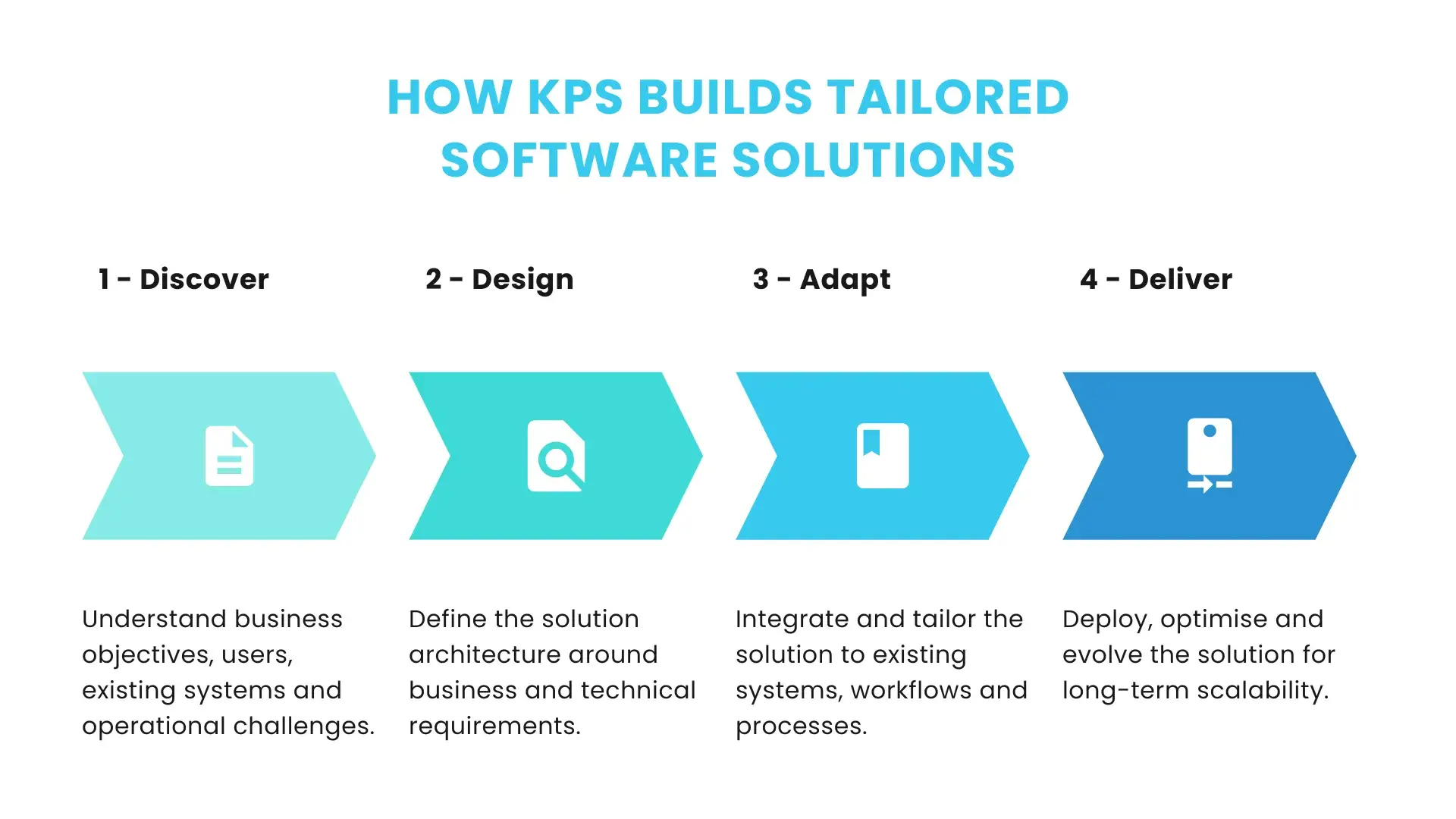
The key is to ensure each stage informs the next, from business requirements through architecture, integration and delivery.
Working alongside trusted industry partners, KPS has successfully delivered tailored digital solutions for organisations across multiple sectors. A practical example is KPS’s Patient Intake Suite, developed for an Australian cardiovascular centre to replace fragmented paper-based assessments and manual follow-ups with a digital workflow. The solution centralised patient information, automated key processes and provided a foundation for future growth.
Choosing the right software solutions partner means finding a team that understands your business, translates complex requirements into practical solutions, and works collaboratively throughout the development journey.
With experience delivering tailored digital solutions across industries, KPS works closely with organisations to build software around their workflows, existing systems and specific business needs.
Our Clients Value KPS For:
“Smooth and collaborative development process.”
Adriano Catalano, Executive Assistant to Professor Prash Sanders
“Professional, efficient, trustworthy and affordable.”
Milly, Founder, MILCO
“Their depth of capability really exceeded my expectations.”
Rob Chapman AM, Executive Chairman
The right software solutions partner does more than build software. They understand your business, translate complex requirements into practical solutions, and work with you to deliver technology that supports your long-term goals.
Looking for a trusted solution partner? Learn more about KPS
Tailored software solutions can deliver long-term value when standard software no longer fits your workflows, systems or growth requirements. By focusing on business fit, measurable ROI and scalability, organisations can turn software into a stronger foundation for operational efficiency and future growth.
Is tailored software expensive?
Initial investment is usually higher than standard SaaS, but compare total cost of ownership, manual effort, integration cost, future change and long-term business value.
How long does tailored software development take?
Timelines depend on scope, workflow complexity, integrations, migration, security requirements and release strategy. A phased MVP can shorten time-to-value when priority capabilities are clearly defined.
Is tailored software secure?
It can be provided security is designed into architecture, identity, access control, data handling, testing, deployment and monitoring from the start. Compliance requirements should be mapped during discovery.
Can tailored software scale with business growth?
Yes. A modular architecture can support additional users, departments, locations, integrations and features. Scalability depends on sound application, data and infrastructure design rather than custom development alone.
How do I choose a software solutions partner?
Assess business understanding, architecture capability, integration expertise, security practices, transparency and ongoing support. Reliable partners should explain trade-offs and document how decisions support operation.
References
(1) Grand View Research, Australia Software Market Size & Outlook, 2025–2030.
(2) Australian Bureau of Statistics, Research and Experimental Development, Businesses, Australia, 2023–24 financial year.


Table of content

Related Insights

From Digitisation to Transformation with Digital Transformation Solutions
Explore the three stages of digital maturity and how Australian businesses can move beyond digitalisation towards meaningful digital transformation with the right approach....

Digital Transformation Strategy: From Strategy to Business Results
Learn how Australian enterprises can turn digital transformation strategy into measurable business results with the right technology solutions partner....

Let’s build what’s next for your business
Tell us about your business challenges, we’ll help you shape the right solution.

